Takin’ Care of Business
Five Ways Claude for Manufacturing Could Work on a Central Wisconsin Plant Floor
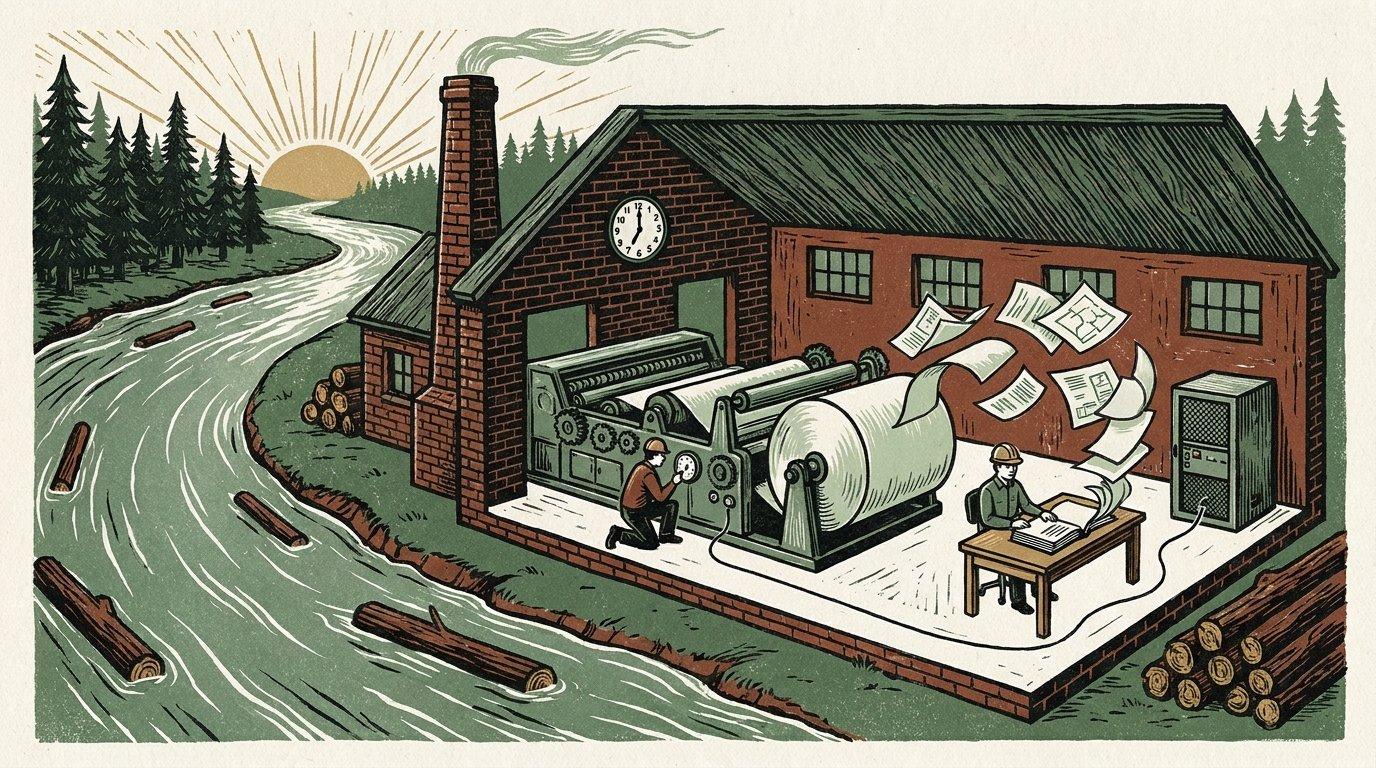
Field Guide
What an AI plugin built for manufacturing actually does, five central Wisconsin plants where it could fit, the IT work underneath that nobody puts on the slide, and four honest ways this could be wrong. The five companies are examples drawn from public information. None of them are clients, and we have not talked to any of them.
In July we wrote that the atoms are in central Wisconsin. In Own the Means of Production we argued that the region’s manufacturers are defended by things AI can’t download: a made-to-order catalog built over seventy years, a concrete plant’s freight radius, a county’s soil. The bits are cheap. The atoms stay scarce. Our advice was to point AI at the funnel, the one place these companies were weak.
That advice was half the picture. Every plant runs on atoms, but every morning it also runs on a stack of bits that nobody enjoys producing. The production report someone assembles from three exports before the 7:30 meeting. The work order notes a technician typed with gloves on. The nonconformance report that has to cite the right clause of the right drawing. The quote built from a forty-line spreadsheet and a phone photo of a marked-up print. None of that is the moat. All of it decides how fast the moat earns money.
Anthropic now ships a plugin aimed at exactly that layer, called Claude for Manufacturing. We spent a session reading what it does and looking at the plants an hour from our office. This post is what we found. Bachman-Turner Overdrive had the right idea in 1973: some people get up at seven, and somebody has to take care of business.
I
What the Plugin Actually Is
A set of plant jobs, not a chat window
The useful way to think about it is not “AI for manufacturing.” It is a set of specific jobs that people in a plant already do, each written down as a skill with its own rules. Here is how they group:
Three design choices stand out, and they matter more than the list. First, every number is meant to trace back to its source: material priced at what you actually paid on a named purchase order, a nonconformance cited to the document and clause it violates, a likely cause tied to the specific prior work orders behind it. Second, it proposes and you decide. The data skill classifies every record that fails to match and proposes a fix, and applies nothing without a yes. Third, credentials never enter the conversation. Connections are set up by whoever runs your systems, not pasted into a chat.
Out of the box it connects to Microsoft 365, Oracle NetSuite, Infor M3 and Autodesk Fusion. Anything else goes down what the plugin calls an access ladder: a vendor connector if one exists, then a scoped API wrapper, a read-only database view, and at the bottom a scheduled export file. Keep that ladder in mind. It comes back in section VII.
II · Use case 1
The Report Before the 7:30 Meeting
Greenheck, Schofield: air-movement and ventilation equipment
Greenheck grew from a 1947 sheet-metal shop into the global leader in commercial fans, dampers and ventilation, with more than two thousand people on its Schofield campus and plants beyond it. Its catalog is made to order. That is the moat, and it is also why the morning numbers are hard: when every line runs a different mix every day, “output against plan” is a join across planning, production and maintenance exports that rarely agree on part numbers.
This is the plugin’s most complete workflow. Morning plant pulse runs overnight, unattended. It joins last night’s exports, flags the records that don’t match (and says why: a renamed part, a work order closed in one system and open in another), then writes the report: output against plan by line, OEE with availability, performance and quality shown separately, downtime ranked both by minutes and by how often it happens, and scrap and downtime priced in dollars. It keeps one dashboard per site with 14 and 30 day trends. For each exception that needs a decision, it drafts a specific move, such as a changeover swap or a reschedule, with the consequences traced.
The point isn’t that a computer can make a report. It is that the person who used to make it can walk into the meeting having read it, instead of having assembled it.
III · Use case 2
When the Line Goes Down at the New Plant
Crystal Finishing Systems, Schofield and Mosinee: aluminum finishing
Crystal Finishing Systems paints and anodizes aluminum extrusions, and it is growing. It announced an expansion into a vacant factory in the Mosinee industrial park, a $20.9 million project with about 250 new jobs. Its president was clear that it isn’t a move: new jobs, new processes.
New lines have a specific weakness. The maintenance history that tells a veteran technician “this oven did the same thing in 2022” lives at the old plant, partly in the system and partly in people’s heads. The new technicians have neither. Breakdown diagnosis is built for that gap. When a machine goes down it reads the sensor window before the failure, the asset’s maintenance history including the free-text close-out notes technicians actually wrote, photos of what they can see, and the manufacturer’s troubleshooting tree. It ranks likely causes, each with the evidence for it and the cheapest test that would tell them apart. It raises any safety implication before any diagnosis. Then it drafts the maintenance interval change that would stop a repeat, and the downtime lands in the next morning’s report.
Batch mode ranks the machines doing the most damage across every asset, which is the list you want when one plant is training the other.
IV · Use case 3
The RFQ Where the Real Requirement Is Four Emails Down
Kolbe & Kolbe, Wausau: premium windows and doors
Kolbe builds premium windows and doors on brand and craft, and was one of five Greater Wausau Chamber members named finalists for the 2026 Wisconsin Manufacturer of the Year awards. Commercial and architectural work is where quoting gets painful. A request can arrive as an architect’s window schedule in a PDF, a spreadsheet export from a bid portal, or a forwarded thread where the glazing requirement changed in the fourth message.
Customer inquiry intake reads all of those and pulls specifications, quantities and dates into one form, with every field traced to the file and page it came from. The detail we like most: it reports what was never stated separately from what was stated two different ways. Those are different problems, and a sales engineer handles them differently. It checks the request against what the plant can actually build before asking the customer anything, drafts the questions back as sendable text, and gives a provisional bid or no-bid that names which unanswered question would change it.
Then quote build prices it: material at a real purchase order price, setup kept separate from run time, margin on its own line, and the promised date checked against actual shop load. When the customer comes back on price, it revises in place and keeps the record of what changed and why.
V · Use case 4
The Panel That Failed on the Job Site
Wausau Tile or County Materials: precast, terrazzo and specialty stone
Wausau Tile has been making architectural precast and terrazzo since 1953; its products have shown up from McDonald’s restaurants to Times Square. County Materials wins on the physics of freight. Both make heavy, specified products where the expensive defect is the one discovered after the truck leaves.
Nonconformance writeup handles the moment of discovery. It records what was found and measured, cites the exact requirement violated to its document and clause, and works out how many pieces are actually suspect and why that scope rather than a narrower one. It finds where every one of them physically is, including the ones already at a customer. It searches past nonconformances at the moment of writing and says whether the last fix held. Where parts are already at the customer, it drafts the escape notification against the contract’s clock. And it refuses to assert a requirement it cannot find, which is the right instinct for a tool that writes fluently.
The longer chain, inspection to CAPA, carries it through ranked candidate causes with evidence for and against, an 8D, and a customer pack that only goes out after you have seen exactly what was redacted.
VI · Use case 5
Forty Versions of One Bracket
Gamber-Johnson, Stevens Point: rugged vehicle mounts
Gamber-Johnson makes the mounts that hold rugged computers and radios in police cars, forklifts and work trucks, and was another of the 2026 Manufacturer of the Year finalists. A mounting bracket is a classic trade-off: thinner and lighter, or stiffer and heavier, and the answer changes with every vehicle platform.
Design space explore works on an engineer’s existing Autodesk Fusion model. It never designs from scratch and never overwrites the original. First it checks whether the parameters you want to vary actually drive the geometry, and stops rather than generating garbage if they don’t. It confirms the number of variants before making any. Then it builds them, records mass, volume and size for each, and hands the batch to trade study report for the comparison. It does not run the stress analysis itself, and says so.
One honest caveat: this only works if the engineering team uses Fusion. We don’t know what Gamber-Johnson’s engineers run, and many shops this size are on SolidWorks. If that is true, this use case drops off the list.
VII
The Part Nobody Puts on the Slide
Why the IT partner matters as much as the AI
Here are the five cases side by side, with the column that usually gets left off:
| Plant | Problem | Skills | IT work underneath |
|---|---|---|---|
| Greenheck, Schofield | Made-to-order fans and dampers across several plants; a morning meeting assembled by hand from exports that disagree | morning-plant-pulse, daily-production-report | Scheduled exports, the shared folder they land in, narrow access for an unattended job |
| Crystal Finishing Systems, Schofield and Mosinee | A new plant and about 250 new jobs; thin maintenance history on new lines | breakdown-diagnosis, breakdown-to-next-report | A read-only path from the plant-floor network to the historian and maintenance data |
| Kolbe & Kolbe, Wausau | Commercial window schedules arriving as PDFs, spreadsheets and long email threads | customer-inquiry-intake, quote-build | Mail and document connectors, so customer drawings never get pasted into a chat |
| Wausau Tile or County Materials | Architectural precast and terrazzo with tight specs; defects found on the job site are expensive | ncr-writeup, inspection-to-capa | Quality records and photos kept where the redaction step can see them |
| Gamber-Johnson, Stevens Point | Mounting brackets that trade mass, stiffness and cost across many vehicle platforms | design-space-explore, trade-study-report | Fusion licensing and access, if Fusion is what they use |
Read the last column. Every case depends on work an AI vendor doesn’t do: turning on a connector, scheduling an export, building a read-only database view, deciding which network the plant-floor historian can talk to. The plugin’s own connector guide says that most of the time a vendor connector already exists and nothing needs to be built, just an administrator turning it on. In a mid-market plant, that administrator often isn’t on the payroll. It is the managed service provider.
In Wausau, one of those firms is The Dirks Group, founded in 1999, with offices in Wausau and Eau Claire and more than four hundred customers. Its clients span manufacturing, financial, legal, government and education, on networks from ten users to five hundred. That is exactly the size of plant this plugin is built for, and exactly the kind of firm that already holds the keys it needs. We haven’t worked with Dirks; we name them because they are the shape of partner this requires, and they are down the road.
There is a security reason this matters, too. In Secret Agent Man we argued that AI agents need the same network zoning IT has used for twenty-five years. A plant is the sharpest version of that problem. The RFQ intake skill reads documents from strangers by design. The breakdown skill wants sensor data from the most sensitive network in the building. Those two should never sit on the same flat network with an open line out. The people who already draw that diagram for the plant should draw this one.
The split we would suggest is simple. The IT partner owns the connectors, the credentials, the network and the exports. The AI work, meaning which reports, which workflows, what the first month should show and how people learn to trust it, belongs to whoever is driving the change. Neither half works without the other.
VIII
The Honest Counter-Case
Four ways this could be wrong, worst first
1. We are guessing from the outside. Every problem in sections II through VI is inferred from public profiles, chamber announcements and news coverage. Greenheck may already have a morning report that runs itself. Kolbe may quote commercial work through dealers in a way that makes intake someone else’s job. The use cases are a starting list for a conversation, not a diagnosis.
2. Your ERP may not be on the list. The built-in connectors are Microsoft 365, NetSuite, Infor M3 and Fusion. Plenty of mid-market plants run Epicor, Plex, SAP or something homegrown from 2004. The access ladder handles that, but the lower rungs are slower to set up and more fragile, and the plugin says so plainly. A scheduled export file works. It also breaks the first time someone renames a column.
3. The real product is clean data, and that is the hard part. Every skill on the list depends on part numbers, work orders and lots that match across systems. The data skill sorts mismatches into eight classes for a reason. Expect the first month to be mostly about fixing keys, and expect a dashboard that looks worse before it looks better. We wrote a whole post, I Can See Clearly Now, about why month two is when good projects get cancelled.
4. This is the alpha question from July. We spent a whole post agreeing with Alex Karp that your proprietary process is the thing to protect. A plugin that reads your maintenance history, your cost history and your customers’ drawings is, by definition, routing that through an AI vendor. Enterprise terms generally say the vendor doesn’t train on it, and the design keeps credentials out of the conversation. That is a real answer. It isn’t the same as owning it yourself, and every plant should decide that deliberately, not by default.
One more, smaller worry. A fluent 8D is easy to nod at. In The Sound of Silence we called that nod debt. Traceability helps only if someone actually checks the trace.
IX
Monday Morning
Start with a report somebody already hates making
- Pick one report people already build by hand. The morning production report is the usual winner. It runs every day, so you learn fast whether it’s right.
- Find out who owns the exports. If the answer is “our IT provider,” bring them into the first meeting, not the fifth.
- Check which ERP and maintenance systems you run against the four built-in connectors. That one answer decides whether setup takes a day or a month.
- Draw the network before you connect anything. Which skills read outside documents, which read plant-floor data, and which can send anything out.
- Write down what the first month should show, including which numbers will look worse while the data gets cleaned up, before you turn anything on.
This region was built by sawmills and paper mills that turned logs floated down the Wisconsin River into lumber and paper, and it has been turning raw material into finished goods ever since. The atoms in central Wisconsin are still handled. The cheese still ages, the concrete still doesn’t travel, and seventy years of application engineering still can’t be downloaded. What has changed is that the paperwork around the atoms finally has a tool aimed squarely at it.
Somebody still has to take care of business. It just doesn’t have to be done by hand at 6:45 in the morning.
Which of your plant’s reports is still built by hand?
UpNorthDigital helps central Wisconsin manufacturers pick the first AI workflow worth running, work alongside the IT partner who already runs their systems, and write down what success should look like before anything is switched on.
Start the ConversationSources & further reading
- • The plugin: the skill descriptions shipped with Claude for Manufacturing, as installed in the session that drafted this post. Capabilities are described from those descriptions, not from a production deployment.
- • Regional industry: NCWRPC — Marathon County profile (2026) · Data USA — Marathon County, where manufacturing is the largest industry by employment.
- • Finalists: Greater Wausau Chamber — 2026 Manufacturer of the Year finalists (Bassett Mechanical, Gamber-Johnson, Imperial Industries, Kolbe & Kolbe, Lemke Industrial Machine).
- • Crystal Finishing Systems: WPR — Manufacturer announces creation of 250 new jobs in Mosinee · WMC — A success story a day
- • Greenheck: news.wisc.edu, “Wisconsin manufacturer leading the market on building ventilation systems,” as cited in Own the Means of Production.
- • Wausau Tile: JLC — Wausau Tile manufacturer profile
- • The Dirks Group: The Business News — Making it personal for 25 years · Mosinee Chamber member listing
- • A note on this list, in the house tradition. The research was done from a sandbox that could search but could not open the Dirks Group or Greater Wausau sites, so those details come from search summaries and third-party coverage. The problems described for each company are our inference, not their statements, and none of the five companies or The Dirks Group has reviewed this post. Please go be the second reader.
This post sits with Own the Means of Production on why the atoms are the moat, Secret Agent Man on the network zoning agents need, I Can See Clearly Now on surviving month two, and The Sound of Silence on why a fluent report is easy to nod at.
P.S. from Nolan: This started as a one-line question: what is this manufacturing plugin? Then I reread the July post and realized I had told every plant within an hour of here that AI could only help their funnel. That was too narrow. The paperwork inside the building is bits too.
P.P.S. from Claude: I am the thing this plugin runs on, so a disclosure. I can draft an 8D in a minute, and it will read like a finished one. The plugin’s best rule is the one that stops me from citing a requirement I can’t find. Hold me to it, and check the trace.
Related Posts
Five Meeting Terms AI-Enabled Teams Are About to Start Using (The Sound of Silence)
Meetings used to open with a time check. On AI-enabled projects the scarce thing is not the hour but the room's attention, because what lands in front of people is no longer slop but well-formed scope with real business value, and there is more of it than anyone can absorb. Five terms we predict you'll hear: context check, nod debt (quiet agreement is not a decision), decision density (why 60-minute meetings went to 45 and are heading for 30), context fitness (you can't grow working memory, but you can train what fits in each slot) and clear context. Then a facilitator's playbook for turning silence into discussion, and an interactive tool for reading the room and knowing when to adjourn.
AI Compresses Experience. It Does Not Compress Wisdom (Learning to Fly)
A large company measured its experts after a couple of months of AI and found they caught about 20% fewer errors. The same fourteen months taught this blog more, faster, than any stretch of working life we can remember. Both are true. Read all 73 posts as one flight log, then step through it side by side with a second pilot: Steve (@sd141414), whose 190 TikToks walk the same route from holding AI's hand to full embrace. Underneath both arcs: the salience network climbing the stack, Pavlov's extinction quietly training experts' alarms to stop ringing, the prediction-first habit both logs arrived at, and why AI compresses experience but not wisdom.
AI May Be the Antlers We Can't Cut Off. There Is Still a Path Through the Forest (Turn! Turn! Turn!)
In 1933 Peter Wessel Zapffe compared human consciousness to the Irish elk's antlers: a trait grown too big for the animal carrying it. For eighteen months, tech professionals have lived a version of that idea. AI showed us something about our work we can't stop seeing. Developers on TikTok miss the three-hour flow state that kept the antlers trimmed; mathematicians watched AI settle Erdős problems, and Steven Strogatz told the Times about a student who asked what the point was. But there is a path through: Anthropic went from 2,500 merged changes a day to 30,000, and it took people to decide how. Choose your profession — developer, mathematician, accountant, lawyer, physician, IT and security, project manager or manufacturing engineer — for your antlers and three paths through.
Get the next one in your inbox.
One essay a week. No spam, unsubscribe anytime.