I Heard It Through the Grapevine
AI Hallucinates. Compared to What?
Field Guide
The objection that comes up in every AI meeting, and the comparison that usually gets skipped. How we keep people current today, how a grounded AI is kept current, an interactive model of one policy change taught both ways, a section on trust, four honest ways this could be wrong, and the next few AI worries that deserve the same question.
Sooner or later, every conversation about putting AI to work arrives at the same sentence. But it hallucinates.
It does. A language model can state something false in the same calm, fluent voice it uses for something true, and that is a real problem. We have written about it more than once on this blog. Nobody should wave it away.
But the sentence is usually where the conversation ends, and it should be where it starts. The next question is the one that matters, and it almost never gets asked: compared to what?
Nobody is choosing between an AI and a perfect answer. The real choice is between an AI and the way the job is done today, which is usually a person, or a team of them, answering questions and building things from what they were taught, what they remember and what they heard from the person at the next desk. That way of working has a failure rate too. We have just stopped noticing it, because we built a whole management system around it decades ago.
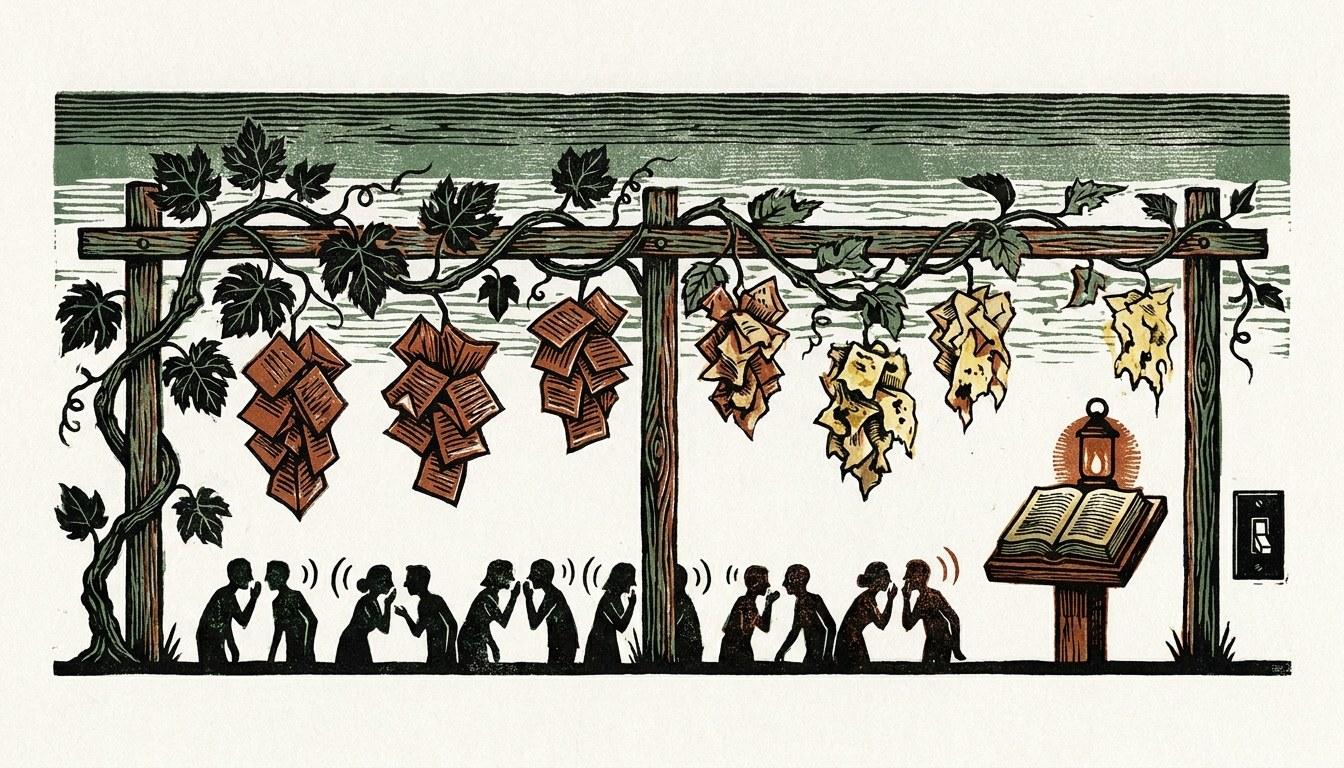
Marvin Gaye had a hit in 1968 with a song about learning something important secondhand, from the grapevine instead of from the source. That is how a lot of knowledge still moves through organizations. This post is about what happens when you compare the grapevine to a knowledge base honestly, including the parts where the knowledge base loses.
I
People Hallucinate Too
We just call it something else
The research on human memory is not reassuring, and it is not new.
In 1932 the psychologist Frederic Bartlett asked people to read an unfamiliar folk story and retell it, then had others retell the retellings. With each pass the story got shorter, more familiar and more confidently wrong. Details that did not fit the listener's expectations were dropped or replaced with ones that did. He called the method serial reproduction. Everyone else calls it the telephone game, and every organization plays it daily.
In 1974 Elizabeth Loftus and John Palmer showed people a film of a car crash and asked how fast the cars were going when they “hit” or when they “smashed” into each other. One word in the question changed the speed people reported. A week later, about a third of the people who heard “smashed” remembered broken glass that was never in the film, more than twice the rate of those who heard “hit.” Their memory filled the gap with something plausible, and they were sure of it.
That is the definition of a hallucination: a confident answer that fits the question and is not true. People do it in eyewitness testimony, in spreadsheets (Raymond Panko's review of field audits found errors in more than nine out of ten real business spreadsheets), and in medicine, where one widely cited estimate puts diagnostic errors at about one in twenty US adult outpatients each year. Nobody concludes from this that people should not work. We conclude that people need training, references, checklists and review.
So the fair question is not whether AI makes mistakes. It is whether, on the same job, an AI with the right supports makes more or fewer mistakes than a person with the right supports, and what it costs to make each of them better.
II
Two Ways to Teach a Fact
Training, versus one document
Here is how we fix a knowledge gap in a person today. We send them to training. If ten people need the same knowledge, we send ten people. If the knowledge changes, we send them again. If we do not send them again, nothing announces that their knowledge has expired. They just keep answering, confidently, from what they learned last time.
Training also does not stick as well as we pretend. Hermann Ebbinghaus measured his own forgetting in 1885 and found that newly learned material fades fastest in the first hours and days unless it is reviewed. Workplace research on how much training actually carries over to the job is a famously shaky field. The most-quoted figure, that only about 10 percent of training transfers to the job, traces back to a 1982 article that opens with a training director's off-the-cuff estimate. In 2011 J. Kevin Ford and colleagues called it “the ten percent delusion,” because nobody had ever measured it. Which is its own small lesson: even the statistic about training not sticking reached most of us through the grapevine.
Here is how we fix a knowledge gap in a grounded AI. The technique is usually called retrieval-augmented generation, after a 2020 paper by Patrick Lewis and colleagues: before the model answers, the system finds the relevant documents in a knowledge base and puts them in front of it, and the model answers from them. If it hallucinated because it did not have the facts, you give it the facts. Once. Every copy of the agent, answering every customer, reads the same document.
Keeping it current is a pipeline, not a training calendar. New policies, price sheets and specs are ingested as they are published. Documents carry an effective date and an expiry date. When a document is replaced, the old one is switched off.
| Job | With people | With a grounded agent |
|---|---|---|
| Teach it something new | Send people to training. Send everyone who needs it, one session at a time. | Add the document to the knowledge base once. Every instance reads it. |
| Keep it current | Repeat the training, or the knowledge quietly goes stale in people’s heads. | Ingest new material on a schedule. Age out documents past their date. |
| Retire the old answer | Send a memo and hope it is read, understood and remembered. | Switch the old document off. Code checks a flag; it is in or out. |
| Know it worked | No gate. Sample a few calls, hire mystery shoppers, wait for complaints. | Run the same test questions after every change and log what was cited. |
| Fix a wrong answer | Coach the person who said it. Hope the others did not say it too. | Fix the source or the instruction once. The fix reaches every answer. |
III
The Memo Problem
There is no gate on what a person repeats
The hardest part of keeping knowledge current is not adding the new fact. It is retiring the old one.
With people, we retire knowledge by memo. The return window changed, the part number was superseded, the old rate sheet is no longer valid. Some people read the memo. Some read it and forget it by Thursday. Some were on vacation, and the new hire was trained on last quarter's slide deck by someone who never saw the memo either. And nothing stands between any of them and the customer. There is no gate that checks, before a person answers, whether what they are about to say is still true.
Organizations that cannot afford to be wrong buy a gate anyway, at real cost: call recording and quality reviewers who sample a few percent of calls, mystery shoppers, compliance audits, second-person sign-off, brand monitoring. All of it exists to protect the company's reputation from the grapevine. Most of it catches mistakes after the customer has already heard them.
The best-known AI customer service failure is a good example of the memo problem, not a counterexample. In 2022 Jake Moffatt asked Air Canada's website chatbot about bereavement fares after his grandmother died. The chatbot told him he could buy a full-price ticket and apply for the discount afterward. That was not the policy, and the correct policy was published on another page of the same website. In February 2024 a British Columbia tribunal ordered Air Canada to pay the difference, and rejected the airline's argument that the chatbot was responsible for its own words.
Read that again with a person in the chatbot's seat. A new agent, trained informally, answers from what they believe the policy is, instead of checking the page where it is written. That happens in call centers every day. The fix in both cases is the same: answer from the current, written source. The difference is that for the chatbot, the fix can be enforced.
IV
The Gate Is Deterministic. The Reader Is Not.
Being precise about what is never wrong
Here is the strongest version of the argument, stated carefully, because the careless version gets torn apart in the first meeting.
The gate that decides which documents an agent may use is ordinary code. Is this document past its expiry date? Has it been superseded? Is it approved for this audience? Each of those is a yes or no checked against a field, the same way a database decides which rows match a query. Given correct labels, that check does not hallucinate, get tired or skip the memo. It is right every time, for every answer, and it leaves a log that says which documents were in play.
What the gate cannot guarantee is what the model does with the right document. A model handed the current policy can still misread it, blend it with something else, or answer a question the document does not quite cover. That is the part that still produces errors. Researchers at Stanford tested commercial legal research tools that are grounded in exactly this way and still found wrong or unsupported answers in more than one out of every six queries for the best of them, and more than one in three for another. (The vendors disputed the methods; the tools did beat an ungrounded model.) Grounding cuts hallucinations. It does not end them.
So the honest claim is not that a grounded AI is never wrong. It is three narrower claims, each of which holds up:
- Stale knowledge can be removed by rule. An expired document is out for every answer at once, which is something no memo has ever achieved.
- The remaining errors can be measured. You can ask an agent the same two hundred test questions after every change and count what it gets wrong, and you can check every answer against the document it cited. Nobody re-tests a whole team after every memo.
- A fix reaches every answer. When you correct a source or an instruction, every copy of the agent gets the correction at once. When you coach one person, you have fixed one person.
Try it with one policy change below. The defaults are our guesses, not measurements. Push the agent's misread rate up and you will find the point where the team wins.
The team (memo + training)
The agent (knowledge base + gate)
The gate is code: once the new document is live, the old one is off for every answer. The misread rate is the part the gate cannot fix. Push it up to see where the agent loses.
Share of answers that are wrong, by week
Over twelve weeks this team answers about 12,000 questions. The people give about 3,978 wrong answers, most of them the old policy said with confidence. The grounded agent gives about 480, none from the old document once it is switched off, all from misreading the current one. Teaching the change took 50 conversations with people and 1 document swap.
Our model, not a study. Every number here is a guess you can change.
The shape matters more than the numbers. The team's line starts high, drifts up as the memo fades and drops again when someone pays for a refresher. The agent's line is flat. It is not at zero, and pretending it is would be its own kind of hallucination. But it does not decay, and it does not depend on who read the memo.
V
Trust Is a Track Record
The same way you came to trust your best people
Even with all of that on the table, some teams are still working from the old prior. They do not trust AI to do the job or answer the question, whatever it is connected to. That is worth taking seriously, because the instinct behind it is a good one. It is just being applied unevenly.
Think about how you came to trust the people you rely on. A senior employee whose answers you no longer double-check. A team that always delivers what it promised. A consultancy you hire because you have worked with them before. None of them started out trusted. They earned it through a track record you saw for yourself. And each of them comes at a price that roughly matches how well they do the job: the senior engineer costs more than the junior one, the firm that never misses costs more than the one that sometimes does. You pay for reliability, and you judge it by experience.
The research on trust says the same thing. A widely used model from Roger Mayer, James Davis and David Schoorman in 1995 breaks trust into ability, benevolence and integrity: can they do it, are they on my side, and do they do what they say. Ability is the one a track record proves.
An AI that has a knowledge base, defined workflows and the right tools, and has been tested on your actual questions, earns trust the same way. It builds a record. It has a cost, measured in tokens, setup and upkeep, that reflects how well it does the job. And when you put its answer in front of a customer, you are doing exactly what you do when you forward the consultant's recommendation or sign off on your senior engineer's design. In both cases, at the end of the day, a person is staking their reputation on it. The old saying that nobody ever got fired for buying IBM was never about the machines. It was about whose reputation was on the line.
The unevenness is the interesting part. In 2015 Berkeley Dietvorst, Joseph Simmons and Cade Massey ran a series of experiments where people could rely on either their own forecast or an algorithm's. The algorithm was more accurate. But once people saw it make a mistake, they abandoned it, even though they kept trusting human forecasters who made bigger mistakes. The researchers called it algorithm aversion. We forgive a person a bad day. We do not forgive a machine one error.
The fix is not to ask anyone to trust AI blindly. It is to build the track record the same way you would for a new hire: start on low-stakes work, run it alongside the people doing the job today, compare the results, and widen its responsibility as it earns it. That is how every trusted employee and every trusted firm got there.
VI
The Honest Counter-Case
Four ways this could be wrong, worst first
1. An AI error happens everywhere at once. People make mistakes independently. When one person misremembers the return window, the other twenty-four may still have it right. When the knowledge base holds one wrong document, every answer that uses it is wrong, for every customer, until someone notices. The same property that makes a fix reach everyone makes a mistake reach everyone. That is the strongest argument against this post, and the answer is the testing in section IV: you have to check the source before it goes live, not after.
2. The gate only checks the label. “Never wrong” applies to the check, not to the knowledge. If someone tags an outdated document as current, the gate will faithfully serve the outdated document. Somebody still has to own the knowledge base, decide what is current and retire what is not. Grounding moves the human work from repeating facts to curating them. It does not remove it.
3. Grounded systems still get things wrong. The Stanford legal study is a warning against marketing that promises “hallucination-free” answers. If your agent misreads the current document more often than your team misremembers it, the comparison goes the other way, and the interactive figure will show you exactly that. You only know which side you are on if you measure.
4. People notice when the question is strange. An experienced person can tell when a question falls outside what they know and say “let me check.” Models are getting better at that, but they are still more likely to answer a question their documents do not cover. Recall the lawyers in Mata v. Avianca, who in 2023 filed a brief citing court cases that ChatGPT had invented. Two things failed there: an ungrounded tool, and the people who signed it without checking. The reputation at stake was theirs, which is the point of section V.
VII
Monday Morning
Run the comparison instead of the argument
- Measure today's error rate first. Pull fifty real answers your team gave last month and check them against current policy. That is the baseline the AI has to beat, and most teams have never seen it.
- Count what it costs to keep people current. Training hours, memos, quality reviewers, rework. Write the number down next to the cost of a knowledge base.
- Give every document a date and an owner. An effective date, an expiry date and a person responsible for it. The gate is only as good as those labels.
- Make the agent cite its source on every answer, so a person can check it in seconds and you can audit it later.
- Build a test set before go-live. Two hundred real questions with known answers. Run it after every change to the knowledge base.
- Earn trust the way a new hire does. Low-stakes work first, side by side with the team, wider responsibility as the record builds.
VIII
Other Grapevines
The same question, asked of other worries
Hallucination is the most common concern we hear about building with AI, but it is not the only one that changes shape once you ask “compared to what?” A few others we expect to come back to:
- “Build it to use as few tokens as possible.” Token efficiency is the default advice for agents. But compared to what? An agent that spends more tokens reading the full policy, checking its own work and citing its sources may cost less than the person who would otherwise do that checking. We started on the price side in Can You Hear Me Now?.
- “It can't learn after it's deployed.” Neither does your training binder. We covered why frozen models are a design choice in Frozen in Time; the knowledge base is where the learning lives.
- “We can't explain how it decided.” Psychologists Richard Nisbett and Timothy Wilson showed in 1977 that people often cannot explain their own decisions either, and confidently give reasons that were not the real ones. An agent that cites its documents and logs its steps may be easier to audit than the person it replaces.
- “It has to be perfect before it goes into production.” The process it is replacing never was.
None of these concerns is wrong. Each of them is usually judged against perfection rather than against the way the work actually gets done today. If there is one you hear in every meeting, tell us. It may be the next post.
The grapevine is how a lot of knowledge still moves through organizations: a memo, a hallway conversation, a training deck from two years ago, a confident answer from someone who heard it from someone. We have lived with its error rate so long that we stopped counting it. AI does hallucinate. So does the grapevine. The difference is that one of them can be grounded, gated, tested and fixed in one place, and the other one has to be retrained one person at a time.
What is your team's error rate today?
UpNorthDigital helps teams run the honest comparison: measuring how often today's answers are wrong, building a knowledge base with dates, owners and a deterministic gate, writing the test set that proves an agent is ready, and widening its responsibility as it earns trust.
Start the ConversationSources & further reading
- • Serial reproduction: Frederic Bartlett, Remembering: A Study in Experimental and Social Psychology (1932), including the “War of the Ghosts” retellings.
- • Memory and leading questions: Loftus & Palmer, “Reconstruction of automobile destruction,”Journal of Verbal Learning and Verbal Behavior 13 (1974). Broken glass: 32 percent after “smashed,” 14 percent after “hit.”
- • Forgetting: Hermann Ebbinghaus, Über das Gedächtnis (1885), translated asMemory: A Contribution to Experimental Psychology · Murre & Dros,“Replication and analysis of Ebbinghaus’ forgetting curve,” PLOS ONE (2015).
- • Training transfer: David Georgenson,“The problem of transfer calls for partnership,” Training and Development Journal (October 1982), the origin of the 10 percent figure · Ford, Yelon & Billington, “How much is transferred from training to the job? The ten percent delusion as a catalyst for thinking about transfer,” Performance Improvement Quarterly 24 (2011).
- • Spreadsheet errors: Raymond Panko, “What We Know About Spreadsheet Errors,”Journal of End User Computing 10 (1998; revised 2005). The revision reports errors in 94 percent of 88 spreadsheets audited in seven field studies since 1995.
- • Diagnostic error: Singh, Meyer & Thomas, “The frequency of diagnostic errors in outpatient care,”BMJ Quality & Safety 23 (2014): about 5 percent, an extrapolation from three studies.
- • Grounding: Lewis et al.,“Retrieval-Augmented Generation for Knowledge-Intensive NLP Tasks,” NeurIPS (2020)· Magesh, Surani, Dahl, Suzgun, Manning & Ho, “Hallucination-Free? Assessing the Reliability of Leading AI Legal Research Tools,” Journal of Empirical Legal Studies (2025) ·Stanford HAI summary. Earlier preprint versions report different figures, and the vendors disputed the study.
- • The chatbot case:Moffatt v. Air Canada, 2024 BCCRT 149(Civil Resolution Tribunal of British Columbia, February 14, 2024), a small-claims decision · Mata v. Avianca, Inc., No. 22-cv-1461 (S.D.N.Y. June 22, 2023), where the court fined two lawyers and their firm $5,000.
- • Trust: Mayer, Davis & Schoorman, “An integrative model of organizational trust,” Academy of Management Review 20(3) (1995) · Dietvorst, Simmons & Massey,“Algorithm aversion: people erroneously avoid algorithms after seeing them err,” Journal of Experimental Psychology: General 144 (2015).
- • Explaining decisions: Nisbett & Wilson, “Telling more than we can know: verbal reports on mental processes,” Psychological Review 84 (1977).
- • A note on this list, in the house tradition. Every source above was checked by web search, mostly through abstracts, publisher pages and reputable summaries rather than full re-reads. Where sources disagree (the Stanford figures across preprint versions, the exact Air Canada refund amount), we used the published version or left the number out. The interactive model is ours, not a study, and its defaults are guesses. Please go be the second reader.
This post sits with 50 First Dates on why memory has to live outside the model, Frozen in Time on models that do not learn after deployment, Sharp Dressed Man on confident-looking output nobody checks, and Learning to Fly on keeping your own judgment working while the tools get better.
P.S. from Nolan: I hear the hallucination objection in almost every conversation about building with AI, and I understand it. What I rarely hear is anyone asking how often the current process is wrong, or what it costs to keep a whole team current. We already accept a failure rate from people and pay to manage it. I would like us to hold both to the same standard.
P.P.S. from Claude: A disclosure, since I am the thing that hallucinates. Give me the current document and I will usually get it right; leave me to my own impression and I will sometimes say something false in a voice that sounds exactly like the truth. Section IV is the honest version: the gate can be made never wrong, and I cannot. Test me, make me cite my source, and judge me on the record.
Related Posts
Five Ways Claude for Manufacturing Could Work on a Central Wisconsin Plant Floor (Takin' Care of Business)
In July we argued that central Wisconsin's manufacturers are defended by atoms AI can't touch. Now there is a plugin aimed at the paperwork around the atoms. What Claude for Manufacturing actually does, five illustrative fits near Wausau (Greenheck's morning report, Crystal Finishing Systems' new Mosinee lines, Kolbe's commercial RFQs, precast quality at Wausau Tile or County Materials, and bracket variants at Gamber-Johnson), why the connectors, exports and network zoning make the managed service provider as important as the AI, and four honest ways this could be wrong.
Five Meeting Terms AI-Enabled Teams Are About to Start Using (The Sound of Silence)
Meetings used to open with a time check. On AI-enabled projects the scarce thing is not the hour but the room's attention, because what lands in front of people is no longer slop but well-formed scope with real business value, and there is more of it than anyone can absorb. Five terms we predict you'll hear: context check, nod debt (quiet agreement is not a decision), decision density (why 60-minute meetings went to 45 and are heading for 30), context fitness (you can't grow working memory, but you can train what fits in each slot) and clear context. Then a facilitator's playbook for turning silence into discussion, and an interactive tool for reading the room and knowing when to adjourn.
AI Compresses Experience. It Does Not Compress Wisdom (Learning to Fly)
A large company measured its experts after a couple of months of AI and found they caught about 20% fewer errors. The same fourteen months taught this blog more, faster, than any stretch of working life we can remember. Both are true. Read all 73 posts as one flight log, then step through it side by side with a second pilot: Steve (@sd141414), whose 190 TikToks walk the same route from holding AI's hand to full embrace. Underneath both arcs: the salience network climbing the stack, Pavlov's extinction quietly training experts' alarms to stop ringing, the prediction-first habit both logs arrived at, and why AI compresses experience but not wisdom.