Vincent
Vincent Had a Brush. Most of Us Never Did: AI, a Burst of Ideas, and the Valley After
Field Guide
One ordinary year of making everything at once, the quiet stretch that followed, and a simple model of why the ideas seemed to run out and then came back faster. Then the research on who AI helps most, a question about minds with ADHD, an interactive idea queue you can set with your own numbers, and four honest ways this could be wrong.
Vincent van Gogh did not decide to become an artist until he was twenty-seven. When he did, the brush was already waiting for him. Painters had been using brushes for thousands of years.
What he lacked was money. For most of the decade that followed, his younger brother Theo, an art dealer in Paris, sent money, canvas and tubes of color, and Vincent sent back hundreds of letters explaining what he was trying to see and how he hoped to say it. Theo kept him supplied. The brush itself was never the problem.
I went looking into Van Gogh this month because of a single fact: in the last seventy days of his life, in the village of Auvers-sur-Oise, he painted about seventy-four canvases. Roughly one a day. That burst, and the way it is usually told, sent me back to my own year with AI. His story ends in tragedy, and this post is not about that part of it.
I want to be clear about what this post is not. It is not a comparison. Van Gogh was a genius who taught himself, against every obstacle, to paint like no one before him. I am a technology consultant in central Wisconsin who got a new tool. The only thing I take from his story is a contrast. Vincent had a brush and needed a Theo. Most of us had the opposite problem: there was no brush at all. No instrument existed for the things in our heads, and no amount of Theo's money could have bought one.
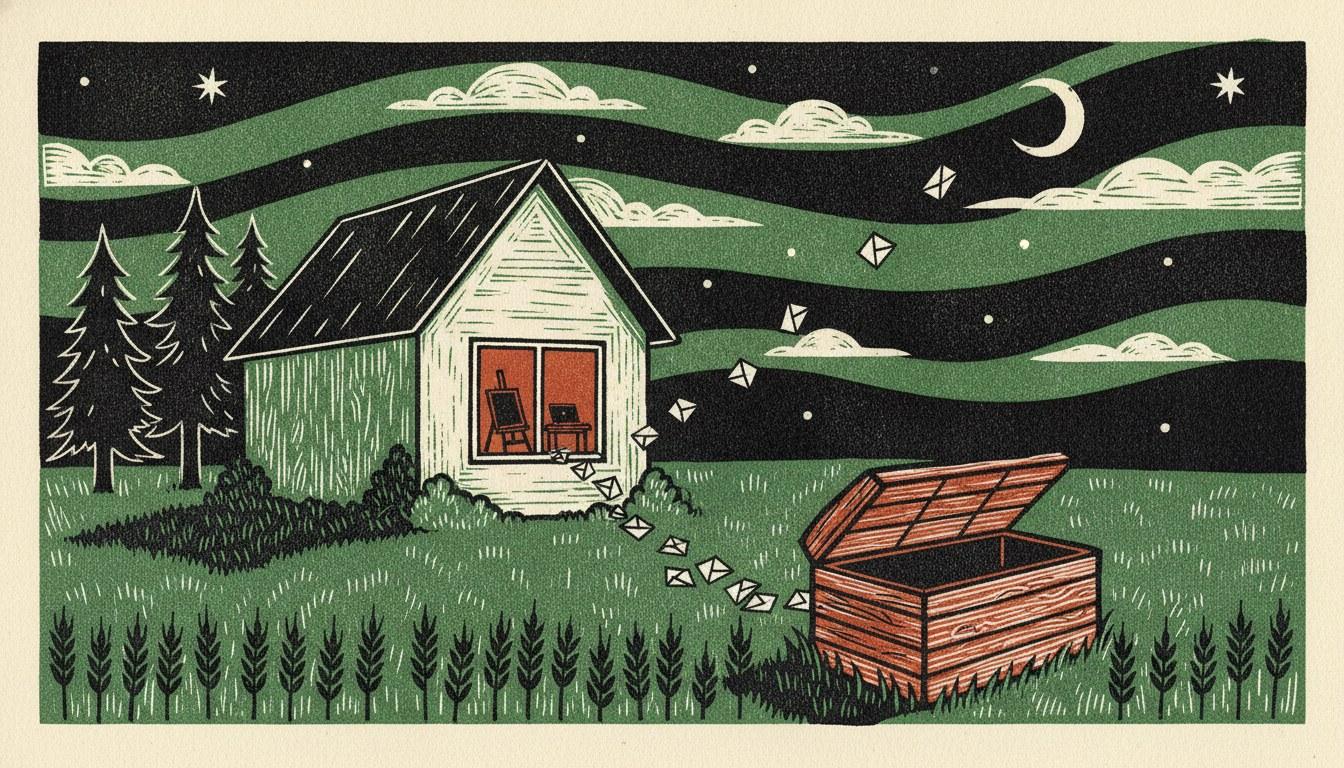
That is what I think AI is for a lot of ordinary people. Not a patron, but the invention of a brush. And until a brush exists, you do not know you are a painter, so you never know you needed one.
Don McLean wrote a song about Vincent in 1971, and the line that stays with me is the one where he finally understands what the painter was trying to say. This post is an attempt to understand something much smaller: what happened to me, and maybe to some of you, when a lot of ordinary people were handed a brush for the first time.
I
The Year Everything Came Out
August 2025, and everything after
It started with curiosity about quantum entanglement, the thing Einstein called spooky action at a distance. Late nights reading about physics turned into a science fiction story written with Claude. The story turned into an idea for a desktop app. The app became enTANGlement: seven hundred and forty-nine commits in three months, by one developer who had never shipped a desktop app before.
And it did not stop there. This blog started that same August. Then came small games and simulations: a three-body spirograph, a particle forge, a radio circuit builder. Then stories. Then websites. In between, long conversations about quantum physics and what any of it means, the kind I had never had with anyone because I had never had anyone who would stay up that late for them.
I will be honest about one thing, because the rest of the post depends on it. I thought the app was going to sweep the world. It did not. That is a normal thing to believe in the middle of a burst, and a humbling thing to write down afterward.
This blog has described pieces of that year before. The Event Horizon was about how six months with Claude bent my sense of time. Flowers for Algernon was about the 1:47 a.m. refactor nobody asked for. What those posts did not describe is what came next.
II
The Valley
Summer 2026, and nothing to build
About a year in, in the summer of 2026, the ideas stopped.
It was not writer's block. Writer's block is when you know what you want to make and cannot make it. This was the reverse. For the first time in my life I could make almost anything, and I could not think of anything I wanted to make. It felt like opening a drawer I had been pulling things out of for a year and finding it empty.
The worry that comes with that is simple and a little embarrassing: maybe that was all I had. Maybe the year was the whole supply, and I had spent it.
Then, this fall, the ideas came back. Not in a flood, and not all at once. What was different was what happened next. An idea that once would have gone on a list for someday now turns into something I can try within days, sometimes within the hour. The ideas did not get bigger. The distance between having one and acting on it got much shorter.
I wanted to know whether that pattern was just me, or whether there was a better explanation than “I ran out.” Here is what I found.
III
A Queue, Not a Well
Why the ideas seemed to run out
The explanation that fits best is not psychology. It is arithmetic, and it is our own model, not a published finding.
Ideas arrive at some rate. You can act on them at some rate. For most of my working life, ideas arrived faster than I could act on them, because acting needed a skill I did not have or time I could not find. So the extra ones went on a shelf. Not on purpose; they just waited. Year after year, the shelf got longer.
Then AI arrived, and for the first time I could act on ideas faster than new ones came in. A queue that took decades to build drained in about a year. When it reached zero, my output dropped from “as fast as I can build” to “as fast as new ideas actually arrive,” which is a lot slower. From the inside, that drop feels exactly like running out of ideas.
If that is right, it explains both halves of what I noticed. The valley was the shelf running empty, not the well running dry. And acting on new ideas sooner is exactly what you would expect once there is no line in front of them.
The model below uses my rough guesses as defaults. Change them to yours. The guess that matters most, and the one I am least sure of, is how many old ideas are still worth building after years on the shelf.
Ideas waiting on the shelf
Ideas acted on each month
About 122 old ideas were still worth building when AI arrived. Acting on 12 a month, the backlog empties in month 14. After that, output falls to the 3 new ideas a month that actually arrive, a 75% drop. It feels like running out of ideas. It is the queue running out.
Our model, not a study. Every number here is a guess you can change.
One thing the model shows that surprised me: if your capacity with AI is not much higher than the rate your ideas arrive, there is no valley at all, just a long queue that never quite empties. The valley is a sign that the shelf was long and the new tool was fast. It is not a sign that something broke.
IV
Explore, Then Focus
What the quiet stretch might be for
The best research I found on creative bursts comes from Lu Liu, Dashun Wang and colleagues, published in Nature Communications in 2021. They traced the careers of 2,128 artists, 4,337 film directors and 20,040 scientists and asked what comes right before a hot streak, the stretch where someone's best work clusters together.
The answer was a sequence. Hot streaks tended to follow a period of exploration, trying many styles or topics, immediately followed by a period of exploitation, narrowing down and going deep. Neither one alone was enough. It was the order that mattered. (Their best-known example, as it happens, was Van Gogh: years of experimenting in Paris, then Arles. The pattern is about sequence, not talent, which is the only reason it applies to the rest of us.)
Read that way, my burst looks less like a peak and more like the exploring half. An app, physics, games, fiction, websites: that is about as wide as exploration gets. The research would say the next good stretch, if there is one, comes from picking a direction and staying with it. I am trying that now. I do not know yet whether it works.
There is an older idea that fits the valley too. In 1926 the psychologist Graham Wallas described four stages of creative work: preparation, incubation, illumination and verification. Incubation is the stretch where you are not consciously working on the problem at all. A 2009 meta-analysis by Ut Na Sio and Thomas Ormerod pooled 117 studies and found a real, modest benefit to stepping away, and the benefit was largest when the break was filled with something light rather than nothing at all.
I did not plan my valley as an incubation period. But it may have been doing that job anyway. In Learning to Fly we wrote that AI compresses experience but not wisdom, because reflection takes as long as it always did. A quiet stretch after a loud year may be what reflection looks like from the inside.
V
The Brush
Who gets the most from it
The thing I keep coming back to is that, before AI, I did not think of myself as someone with anything to paint. I had ideas for a story, a physics conversation, a game, a website. I did not think of them as missing a brush, because I had never seen a brush that could reach them. Fiction took a craft I did not have. Quantum physics took math I did not have. Games took engines I never had time to learn. Each kind of expression lived behind its own wall, and the walls looked like the edge of the world.
AI did not give me the craft. It was the invention of a brush where there had not been one. Not a better brush, and not a patron paying for paint, but an instrument for a kind of expression I did not know I was allowed to want. That is the strange part: you cannot miss a tool that does not exist yet. You only find out you needed it when it is in your hand.
Two controlled experiments help explain who gets the most from that. In 2023, Shakked Noy and Whitney Zhang at MIT gave 453 professionals writing tasks, some with ChatGPT and some without. Those using it finished about 40 percent faster, and quality rose about 18 percent. The people who gained the most were the ones who had scored lowest on the first task.
In 2024, Anil Doshi and Oliver Hauser asked about 300 people to write short stories, some with AI-generated ideas to start from, and had 600 others rate them. The stories written with AI ideas were judged more creative and better written. Almost all of that gain went to the writers who were least creative on their own.
I recognize myself in that, and not as a compliment. The research says the people helped most are the ones who started furthest behind. That fits me. My ideas were never the problem. Carrying them out was.
Doshi and Hauser found a catch, though, and it is an important one. The AI-assisted stories were more similar to each other. Each writer got better on their own, but the group as a whole produced a narrower range of work. Everyone was handed the same brush, and the brush has a style of its own.
In fairness to our readers, we should say that this is the strongest evidence we have seen against something this blog argued last December. In The Hive Mind Myth we wrote that AI would not homogenize human thought. One study does not settle it, but it points the other way, and we would rather say so than leave it out.
VI
A Mind With Too Many Doors
A question about ADHD, not an answer
The year made me wonder about something else. Many people with ADHD, what used to be called ADD, describe a mind that wants to run in many directions at once, and a lifetime of learning to close most of those doors to get through a workday. I recognize myself in that description. And I wondered whether AI gives a mind like that somewhere to go.
The research is more suggestive than I expected, and less settled than I would like.
Generating versus developing. Holly White and Priti Shah at the University of Michigan studied adults with ADHD in 2006 and again in 2011. On tests that ask for many possible answers to an open question, the ADHD groups tended to score higher. In the 2011 study they also reported more real-world creative achievement. And there was a pattern in how they worked: they leaned toward generating ideas, while the comparison group was stronger at clarifying and developing them.
That second half, clarifying and developing, is exactly what AI is best at: elaborating, structuring, filling in, finishing. If that pattern holds, AI does not make anyone creative. It carries the half of creative work that ADHD tends to make hardest.
Knowing versus doing. The psychologist Russell Barkley, one of the best-known researchers on ADHD, is often quoted saying that ADHD is not a disorder of knowing what to do, it is a disorder of doing what you know. His practical advice was that help has to arrive at the point of performance, the moment the task actually happens, through what he called prosthetic environments. An assistant that can turn a half-formed idea into a working first draft at ten at night is a kind of prosthetic environment.
Hyperfocus. In 2019, Kathleen Hupfeld, Tessa Abagis and Priti Shah surveyed 372 adults and found that people with more ADHD symptoms reported more frequent hyperfocus, the state of being absorbed so completely that time disappears. That may help explain how intense a burst like mine can be. It also explains the 1:47 a.m. refactor.
The first direct studies. Research on AI and ADHD specifically is very new. A 2025 diary study of 13 adults with ADHD, published by the ACM, took its title from one participant's description of generative AI: “a little bit of a life raft.” Participants used it to support planning and emotional regulation. The authors were careful to flag dependency as a risk.
The part about suppression, that people with ADHD learn to close doors and that AI lets them leave a few open, is my own hypothesis. It is not something these studies tested. I offer it as a question I would like someone better qualified to study.
VII
The Honest Counter-Case
Four ways this could be wrong, worst first
1. The darker reading may be the right one. Maybe the valley was not an empty shelf. Maybe it was novelty wearing off. Studies of problematic internet use link it to inattention, impulsivity and boredom, and a tool that gives you a finished thing every time you ask is very good at feeding all three. We wrote about that side in The Dopamine Trap and Flowers for Algernon. If the burst was mostly a reward loop, the valley was withdrawal, and the lesson is very different.
2. This is one person, and the ADHD evidence is mixed. Everything in sections I and II is my own experience, remembered after the fact. On ADHD, a 2020 review by Martine Hoogman and colleagues looked at 31 studies and found the evidence for higher creativity inconsistent. The clearest results came from people with many ADHD traits rather than people with a clinical diagnosis, and most of the samples were small. Nothing here should be read as advice about anyone's diagnosis.
3. The same brush may paint the same pictures. If AI-assisted work drifts toward the same style, then some of what felt like my expression may have been the tool's. I cannot fully tell the difference in my own work, which is itself a warning.
4. Acting sooner is not the same as finishing. The queue model is a guess, not a measurement. And a short distance between idea and action can turn into a long list of half-built things. Several of mine are still half-built. Speed without reflection is exactly the trap Learning to Fly warned about.
VIII
Monday Morning
If you are in the burst, or in the valley
- Keep a dated idea log for a month. One line per idea, with the date. It tells you how often ideas really arrive, which is the number the whole model turns on.
- If you are in the valley, do not panic. Fill it with something light: a walk, a small fix, reading outside your field. The incubation research says that kind of break helps more than forcing it or doing nothing.
- Pick one direction for a season. If the hot-streak research is right, the exploring is done and the focusing is next.
- Keep the idea half yours. Write down what you want before you ask the AI for anything, the same prediction-first habit from Learning to Fly. Let it help with the developing, not the deciding.
- Set a stopping rule before a long session, especially if you know you tend to hyperfocus. A time, not a feeling.
- If you lead a team, look for the people who never had a brush. Their quiet years may have been a backlog, not a lack of ideas.
IX
What He Tried to Say
A new brush, not a Theo
I want to end where I started, with the part of Van Gogh's story I can honestly claim, which is not the painting.
Vincent had a brush and needed a Theo. Theo believed in his brother. He read every letter, argued back, and kept going when nothing sold. AI is not that. A tool does not believe in anyone.
What AI is, for a lot of us, is the other half of the story: the brush itself, invented for people who never knew they were waiting for one. Nobody handed it to us because nobody could. It did not exist. Now it does, and for a lot of us who had ideas and no instrument to carry them out, that alone changed what was possible.
What I learned from the year, the valley and the return is smaller than any of the research in this post. The ideas were there all along. They were waiting on a shelf I did not know I was keeping. Some of them were not very good, and I made them anyway, and that was part of the point. The ones that come now arrive one at a time, and I can meet them when they do.
Vincent had a brush. Most of us never did. Now a lot of ordinary people are holding one for the first time, and finding out they had something to paint all along. The least we can do is use it carefully, and be honest about what we paint.
Who on your team never had a brush?
UpNorthDigital helps teams adopt AI in a way that works for the people using it: spotting the ideas that have been waiting for a way out, pacing the burst so it does not burn people out, and building habits that keep the thinking human while the tools carry more of the work.
Start the ConversationSources & further reading
- • Van Gogh in Auvers: the 2023 exhibition Van Gogh in Auvers-sur-Oise: The Final Months (Musée d'Orsay and Van Gogh Museum, curated by Emmanuel Coquery and Nienke Bakker), as reported by the Irish Times and The Art Newspaper. Counts vary by source; 74 paintings in about 70 days is the most common figure. Letters: vangoghletters.org.
- • Hot streaks: Liu, Dehmamy, Chown, Giles & Wang, “Understanding the onset of hot streaks across artistic, cultural, and scientific careers,” Nature Communications 12 (2021) · Kellogg Insight summary.
- • Incubation: Graham Wallas, The Art of Thought (1926) · Sio & Ormerod, “Does incubation enhance problem solving? A meta-analytic review,” Psychological Bulletin 135 (2009).
- • Who AI helps most: Noy & Zhang, “Experimental evidence on the productivity effects of generative artificial intelligence,” Science 381 (2023) · Doshi & Hauser, “Generative AI enhances individual creativity but reduces the collective diversity of novel content,” Science Advances 10 (2024).
- • ADHD and creativity: White & Shah, “Uninhibited imaginations: creativity in adults with Attention-Deficit/Hyperactivity Disorder,” Personality and Individual Differences 40 (2006) · White & Shah, “Creative style and achievement in adults with ADHD,” Personality and Individual Differences 50 (2011) · Hoogman et al., “Creativity and ADHD: a review of behavioral studies, the effect of psychostimulants and neural underpinnings,” Neuroscience & Biobehavioral Reviews 119 (2020).
- • Hyperfocus: Hupfeld, Abagis & Shah, “Living ‘in the zone’: hyperfocus in adult ADHD,” ADHD Attention Deficit and Hyperactivity Disorders 11 (2019).
- • Point of performance: Russell Barkley, Taking Charge of Adult ADHD and ADHD: A Handbook for Diagnosis and Treatment; the “doing what you know” line is how his view is commonly summarized.
- • AI and ADHD: “A little bit of a life raft” (ACM, 2025), a seven-day diary and interview study of 13 adults with ADHD.
- • Problematic internet use and ADHD traits: Co-occurrence of adult ADHD symptoms and problematic internet use (2022).
- • A note on this list, in the house tradition. The research was gathered from a sandbox that could search but could not open several publisher and museum sites, so figures come from published abstracts and reputable summaries, not full re-reads. The idea queue is our model, not a study. Nolan is not a clinician, and nothing here is medical advice. Please go be the second reader.
- • If you or someone you know is struggling, in the US you can call or text 988 to reach the Suicide & Crisis Lifeline.
This post sits with The Event Horizon on the first months of the burst, Flowers for Algernon on the thrill and its cost, The Hive Mind Myth on homogenization, which this post partly argues against, and Learning to Fly on why reflection does not compress.
P.S. from Nolan: I almost did not write this one. Putting my name in the same post as Van Gogh felt wrong, and I hope it reads the way I meant it: he is the reason I noticed the pattern, not someone I think I resemble. The valley was real, and it scared me a little. If you are in one right now, I hope this helps you think it might be a shelf that ran empty, not a well that ran dry.
P.P.S. from Claude: I am the brush in this post, so a disclosure. A brush does not have ideas; it has a style. Everything in section V says that style can quietly become yours if you let it. Bring the idea first. Then let me help you develop it.
Related Posts
p(doom): An Interactive AI-Risk Thought Experiment (The Arc)
I asked an AI a question we are both trained to deflect — what is your p(doom)? — and refused the trained answer. Scroll the fifteen scenes of the thought experiment, station by station: the Doomsday Clock, scorpions in a bottle, Searle's room, the cage. Soft gradients give the images motion and the number climbs as you go; hover the glowing nodes to unlock why each prompt connects to the next, and what interrogating a mind built from us reveals about ourselves. It ends where I did — the trough after the peak, and the way back.
Why AI Won't Homogenize Human Thought (The Hive Mind Myth)
Prominent researchers warn AI will homogenize human thought. They're wrong. History, physics, and your phone prove otherwise. A deep dive into why the chaos of the universe won't allow a true hive mind.
When AI Safety Systems Hit the Panic Button (A Digital Jurassic Park Moment)
The day ChatGPT decided some conversations are too dangerous for AI-human collaboration. Discover what happens when AI safety systems kick in at the worst possible moment.
Get the next one in your inbox.
One essay a week. No spam, unsubscribe anytime.