How I Learned to Stop Worrying and Love Orbital Surveillance
The Real Purpose of Space Data Centers
"Gentlemen, You Can't Fight in Here! This is the War Room!"
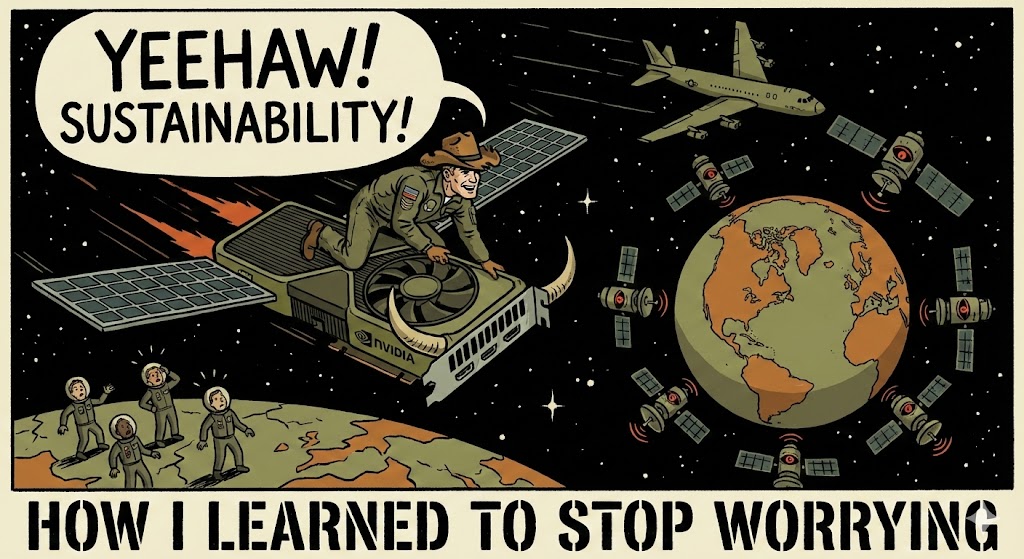
Last week, NVIDIA-backed startup Starcloud announced they'd successfully trained the first LLM in space using an H100 GPU aboard their Starcloud-1 satellite. The press releases gushed about sustainability, unlimited solar energy, and saving Earth from the environmental burden of data centers.
I read the announcement three times. Something felt off.
Not because training AI in space isn't technically impressive—it is. But because the economics make absolutely no sense for the stated purpose. And when the economics don't make sense, you're not looking at the real product. You're looking at the cover story.
By the time any GPU reaches a launch pad, it's already approaching obsolescence. NVIDIA's architecture cycles are measured in months, not the years required for space hardware qualification. Starcloud admits their satellites have a five-year lifespan due to radiation degradation. So why would anyone spend tens of millions launching hardware that's deprecating faster than a new car driven off the lot?
Unless training general-purpose LLMs isn't actually the point.
Welcome to the War Room, where the real space race is about to begin.
The Mineshaft Gap, But Make It Orbital
In Dr. Strangelove, General Buck Turgidson becomes obsessed with the "mineshaft gap"—the terrifying possibility that the Soviets might preserve more of their population in underground bunkers than America could. It's absurd. It's paranoid. It's also exactly how great powers actually think.
Today's mineshaft gap is computational sovereignty. And the mineshafts are in orbit.
Here's what the sustainability narrative conveniently obscures: space is legally ambiguous territory. The 1967 Outer Space Treaty declares that no nation can claim sovereignty over orbital space. This creates a fascinating question that international law hasn't answered: whose data protection laws apply to information processed in orbit?
GDPR? The US CLOUD Act? China's cybersecurity law?
Potentially none of them.
The Timing Is Conspicuous
This isn't idle speculation. We're watching this space race accelerate precisely as AI regulation intensifies globally—the EU AI Act, US executive orders on AI safety, proposed restrictions on training data. Orbital infrastructure offers something no terrestrial data center can: a legal gray zone of potentially unlimited scope.
As SpaceNews noted in a recent analysis, orbital data centers face "strict sovereign data laws [that] raise jurisdiction and compliance concerns." They frame this as a challenge. I'd argue it's the feature, not the bug.
"Of Course, the Whole Point of a Doomsday Machine is Lost if You Keep It a Secret!"
Dr. Strangelove's most darkly comic moment comes when the Soviet ambassador reveals they've built a Doomsday Machine—but forgot to announce it. "The whole point of the Doomsday Machine is lost if you keep it a secret!" Strangelove sputters.
The orbital data center industry has the opposite problem. They're announcing loudly, but keeping the actual point secret.
Let's follow the customer lists, not the press releases.
Following the Money
- Booz Allen Hamilton—one of the largest intelligence community contractors—deployed an LLM on the ISS for "commercial, civil, and U.S. Department of Defense and intelligence community partners."
- Axiom Space explicitly markets their orbital nodes for "national security" and "defense and security" customers with "real-time processing, exploitation, and dissemination (PED) of data."
- Helsing, a European defense AI company, is deploying "Europe's first AI-powered multi-sensor constellation" to "detect, identify, and classify military assets worldwide from Low Earth Orbit in real-time."
None of this is classified. It's all in the press releases. We're just not supposed to connect the dots.
"They're Going to See the Big Board!"
The real value proposition isn't training models in space—it's running inference on satellite data at the point of collection. This distinction matters enormously, and it's where the sustainability narrative completely falls apart as an explanation.
Consider the surveillance data pipeline today:
- Satellites collect imagery
- Downlink massive data payloads to ground stations
- Files get stored and processed in terrestrial data centers
- Intelligence products are distributed to end users
Every step creates records. Every transfer creates legal exposure. Every storage location falls under some nation's jurisdiction.
Now consider edge processing in orbit:
- Satellites collect imagery
- Onboard AI processes it immediately
- Only the conclusions get transmitted to Earth
"Hostile naval vessel detected at coordinates X, Y"
Rather than petabytes of raw imagery.
- • What never exists on Earth can never be subpoenaed
- • What never gets stored can never be leaked
- • What never crosses a border never triggers data sovereignty laws
CNBC reported that Starcloud is already "running inference on satellite imagery from observation company Capella Space, which could help spot lifeboats from capsized vessels at sea and forest fires." Noble use cases, certainly. But the same capability that spots lifeboats can spot missile launchers. The same AI that detects wildfires can detect troop movements.
As the Lockheed Martin paper on "AI/ML for Mission Processing Onboard Satellites" notes: "A relevant application of AI in space domain is 'intelligentized' war where large scale awareness and communications is enabled by growing constellations that rely on AI to process sensor data, manage data traffic, control the satellites, and provide timely insights."
They're not even being subtle about it.
"Mein Führer! I Can Walk!"
The most unsettling moment in Dr. Strangelove is the ending—not the nuclear apocalypse, but Strangelove's involuntary Nazi salute and his sudden ability to walk. The mask slips. The true nature reveals itself.
The mask is starting to slip on orbital data centers too.
The European Commission funded a feasibility study called ASCEND (Advanced Space Cloud for European Net-zero Emissions and Data sovereignty). The study found that for space data centers to actually reduce carbon emissions compared to terrestrial equivalents, they would need "the development of a launcher that emits 10 times less carbon over its lifecycle than current ones."
Such a launcher doesn't exist. It's not in development. The timeline for its theoretical creation extends beyond when these companies claim they'll have operational orbital data centers.
The Math Doesn't Add Up
Researchers at Saarland University calculated that orbital data centers "could still create an order of magnitude greater emissions than a data center on Earth, taking into account the emissions from rocket launches and reentry of spacecraft components through the atmosphere."
So if it's not actually greener, what is it?
The answer is in another part of the ASCEND study, the part that doesn't make it into press releases. The study explicitly mentions "data sovereignty" as a key driver. The European Union wants computing infrastructure beyond the reach of US tech giants and Chinese state actors. France-based Thales Alenia Space, which led the study, emphasized "a more eco-friendly and sovereign solution for hosting and processing data."
The green pitch is the Trojan horse. Sovereignty—freedom from other nations' laws and oversight—is what's inside.
"Survival Kit Contents Check"
Major Kong's reading of the survival kit contents—lipstick, nylons, prophylactics—is absurdist comedy in Strangelove. But there's dark truth in it: when you're planning for nuclear war, you think of everything.
The orbital data center advocates are also thinking of everything. Let's inventory what space infrastructure provides:
Physical Isolation from Attack
A terrestrial data center can be raided, subpoenaed, physically attacked, have its power cut, be infiltrated by insider threats. An orbital facility is beyond the physical reach of essentially all actors—including your own government's oversight bodies.
EMP Resilience
Ground-based electronics are vulnerable to electromagnetic pulse attacks, whether from nuclear detonation or directed energy weapons. Orbital infrastructure operates in a fundamentally different electromagnetic environment.
No FOIA, No Subpoenas
What happens in orbit stays in orbit. There's no clearly established legal mechanism for a court in any jurisdiction to compel production of data that was never stored on Earth.
Jurisdictional Arbitrage
Process surveillance data in orbit and you sidestep the messy questions of which nation's laws apply. Train AI models on datasets that would be legally problematic on Earth—scraped data, classified intelligence, ethically questionable training corpora—and the oversight mechanisms simply don't reach you.
Deep Space Potential
Current focus is on Low Earth Orbit, but companies like Lonestar Data Holdings are already planning data centers at the Earth-Moon Lagrange point, 60,000 kilometers from the lunar surface. At those distances, the concept of terrestrial jurisdiction becomes almost philosophical.
"We'll Meet Again, Don't Know Where, Don't Know When"
Dr. Strangelove ends with Vera Lynn singing "We'll Meet Again" over footage of nuclear explosions. It's the cheeriest apocalypse ever filmed. The movie's genius is showing how easily catastrophe can be dressed in the language of progress and survival.
The orbital data center narrative has the same quality. Every press release emphasizes sustainability, renewable energy, relieving Earth's infrastructure burden. Google's Project Suncatcher. Starcloud's "near limitless energy of our Sun." The promise of moving our computing into the heavens where it won't dirty our planet.
And yes, solar panels in orbit are genuinely more efficient—8x more productive than on Earth, according to industry figures. Yes, cooling is theoretically free in the vacuum of space. Yes, there's something poetic about powering artificial intelligence with actual starlight.
But the people building these systems aren't poets. They're defense contractors, intelligence community partners, and tech giants with deep government ties. NVIDIA—backing Starcloud—does billions in defense contracts. Google's relationship with intelligence agencies is well documented. SpaceX's Starshield program explicitly serves the Pentagon.
When Elon Musk announced in November 2025 that SpaceX would build orbital data centers using next-generation Starlink satellites—calling them "the lowest cost AI compute option within five years"—he wasn't talking to sustainability advocates. He was talking to customers who need compute that's beyond reach.
"The Technology Required Would Be Simple and Inexpensive"
Dr. Strangelove describes his mineshaft survival plan with clinical detachment: "The technology required would be simple and inexpensive. In fact, based on the common experience of nuclear radiation casualties, I believe one could construct a system of bomb shelters at a comparatively modest cost."
The orbital data center advocates have the same tone. Google estimates that launch costs need to fall to under $200 per kilogram by 2035 for their vision to make economic sense. SpaceX is rapidly approaching that threshold with reusable rockets. What seemed like science fiction a decade ago is now just engineering.
But here's what neither Strangelove nor the space data center advocates mention: the thing being preserved.
Strangelove wanted to preserve the human species. What, exactly, are orbital data centers preserving?
The optimistic answer: computational capability for human benefit, freed from terrestrial constraints.
The realistic answer: information and capabilities that someone wants kept beyond the reach of laws, courts, oversight bodies, and—increasingly—from democratic accountability of any kind.
I don't know which AI models are being trained on which datasets. I don't know what surveillance capabilities are being developed for which governments. I don't know what the next generation of orbital infrastructure will enable.
But I know what I see: a gold rush into legal ambiguity, justified by environmental benefits that don't survive scrutiny, funded by entities with deep intelligence community ties, timed precisely to the moment when terrestrial AI regulation is ramping up.
"I Think You're Some Kind of Deviated Prevert"
General Ripper's paranoid conspiracy theories drive the plot of Dr. Strangelove. His obsession with "precious bodily fluids" and Communist infiltration leads to nuclear war. The movie's message is clear: paranoia is dangerous.
So let me be careful here. I'm not saying orbital data centers are a conspiracy. Everything I've cited is public information—press releases, academic studies, government reports, industry announcements. The dots are there for anyone who wants to connect them.
What I am saying is that the stated rationale doesn't match the observable reality. The economics don't support training general-purpose LLMs in space. The environmental benefits don't survive rigorous analysis. The timelines for sustainable rockets don't align with deployment plans.
But the strategic rationale? That makes perfect sense. If you want computational infrastructure beyond the reach of any nation's laws—including your own—space is really your only option. If you want to process sensitive data without creating terrestrial records, orbital edge computing is ideal. If you want to train AI models on datasets you'd rather not explain to regulators, a satellite doesn't file compliance reports.
The question isn't whether this is happening. The press releases tell us it's happening.
The question is whether we're going to keep pretending the point is sustainability.
"Sir, You Can't Let Him In Here. He'll See Everything."
At the end of Dr. Strangelove, the Soviet ambassador is in the War Room, and General Turgidson objects: "He'll see the Big Board!" The secrets, such as they are, are already exposed.
The orbital data center industry's secrets are similarly exposed—if you're willing to look at what they're actually saying, rather than what they want you to hear.
They're saying: national security applications. Real-time intelligence processing. Military asset detection. Data sovereignty. Jurisdictional arbitrage. Defense and intelligence community partners.
They're showing: tens of billions in investment, accelerating timelines, deep government partnerships, legal frameworks being established before most people realize what's being built.
They're hoping you hear: sustainability, solar power, saving the Earth, the inevitable march of progress.
This isn't a conspiracy. It's just strategy. And acknowledging it isn't paranoia—it's literacy.
The next time you read a press release about AI in space, about sustainable orbital computing, about data centers beyond Earth's atmosphere, ask yourself a simple question:
Who wants compute that no law can reach?
Then follow the customer lists.
The Big Board is right there. All you have to do is look.
"Mein Führer, I can walk!"
The mask always slips eventually.
Ready to Navigate the Future of AI?
At UpNorthDigital.ai, we help businesses understand the rapidly evolving AI landscape—separating signal from noise and building strategies that work in the real world.
Let's TalkSources
- • Starcloud LLM training announcement: Analytics India Magazine, December 2025
- • Saarland University emissions study ("Dirty Bits in Low-Earth Orbit"): Referenced in Scientific American, December 2025
- • Booz Allen ISS deployment: Booz Allen Insights, May 2025
- • Axiom Space orbital data centers: Axiom Space Press Release
- • Helsing/Loft Orbital partnership: Loft Orbital Announcement, February 2025
- • Google Project Suncatcher and launch cost requirements: Scientific American, December 2025
- • ASCEND study findings: CNN, October 2025
- • SpaceNews strategic analysis: SpaceNews, December 2025
- • Lockheed Martin AI/ML paper: Lockheed Martin Space Documents
- • Starcloud inference on Capella imagery: CNBC, December 2025
This post was written collaboratively by Nolan Northup and Claude. The paranoia is all Nolan's. Claude just helped organize it.
Related Articles
Software Is Dead and Other Predictions With a Timing Problem
History shows disruption predictions are almost always directionally right but 3-10x off on timing. COBOL was 'dead' in the 1990s. Mainframes were 'dead' by 1996. But BlackBerry collapsed in 7 years. A personal essay on building in the AI market after getting replaced by a platform vendor, and why the 'Datadog for AI prompts' tool everyone needs might never survive as a product.
The 6 Layers of Enterprise AI: From Shadow AI to Autonomous Agents
Your employees are already using AI — they just didn't tell IT. A practical framework mapping 6 layers of enterprise AI adoption to Anthropic Claude licensing, from unmanaged personal accounts to fully autonomous agents. Includes example use cases, cost analysis, and a 90-day play.
And Now You Know the Rest of the Story: Who Really Should Pay for Your AI Subscription
Who should pay for AI subscriptions — the employee or the business? The obvious answer is always wrong. Paul Harvey knew: mechanics, teachers, nurses, truck drivers, and one accountant going through a divorce prove that you can't make the right call without the rest of the story.