Turn! Turn! Turn!
AI May Be the Antlers We Can't Cut Off. There Is Still a Path Through the Forest
Field Guide
A 1933 essay about an extinct elk, the developers who miss the flow state, the mathematicians who just watched AI settle problems they built careers around, and what it took Anthropic to merge 30,000 changes a day. Then an interactive section where you choose your profession and see three paths through. The opening and the closing are written for everyone.
At a town hall meeting in a university math department this fall, a student in the back of the room asked the question everyone else had been avoiding: what's the point?
Steven Strogatz, who teaches mathematics at Cornell, told the story on the New York Times' The Daily in October. The student's argument went like this. If AI can do math better than any human being, sure, I can learn from it. But “I wanna discover things too. I want that thrill. And also, I don't want my life to be in vain.” Strogatz agreed with every word, and a few minutes later his voice broke on air while he explained what he had found when he went looking for an answer.
Software developers had that town hall about a year earlier, except nobody called it one. It happened in standups and pull request threads and in the gap between prompting an agent and reviewing what it built. Accountants, lawyers, doctors and project managers are having theirs now or will be soon.
This post is about that question, and about an old, very dark essay that describes the feeling better than anything written about AI. It is also about the way through, because there is one. We have watched people take it.
I
The Elk With Too Much Antler
A 1933 essay, rediscovered on TikTok
In 1933 the Norwegian philosopher and mountaineer Peter Wessel Zapffe published an essay called The Last Messiah. It is one of the bleakest things anyone has written about being human, and it recently turned up on TikTok in a philosophy explainer that opens with “you're gonna wanna sit down for this one.”
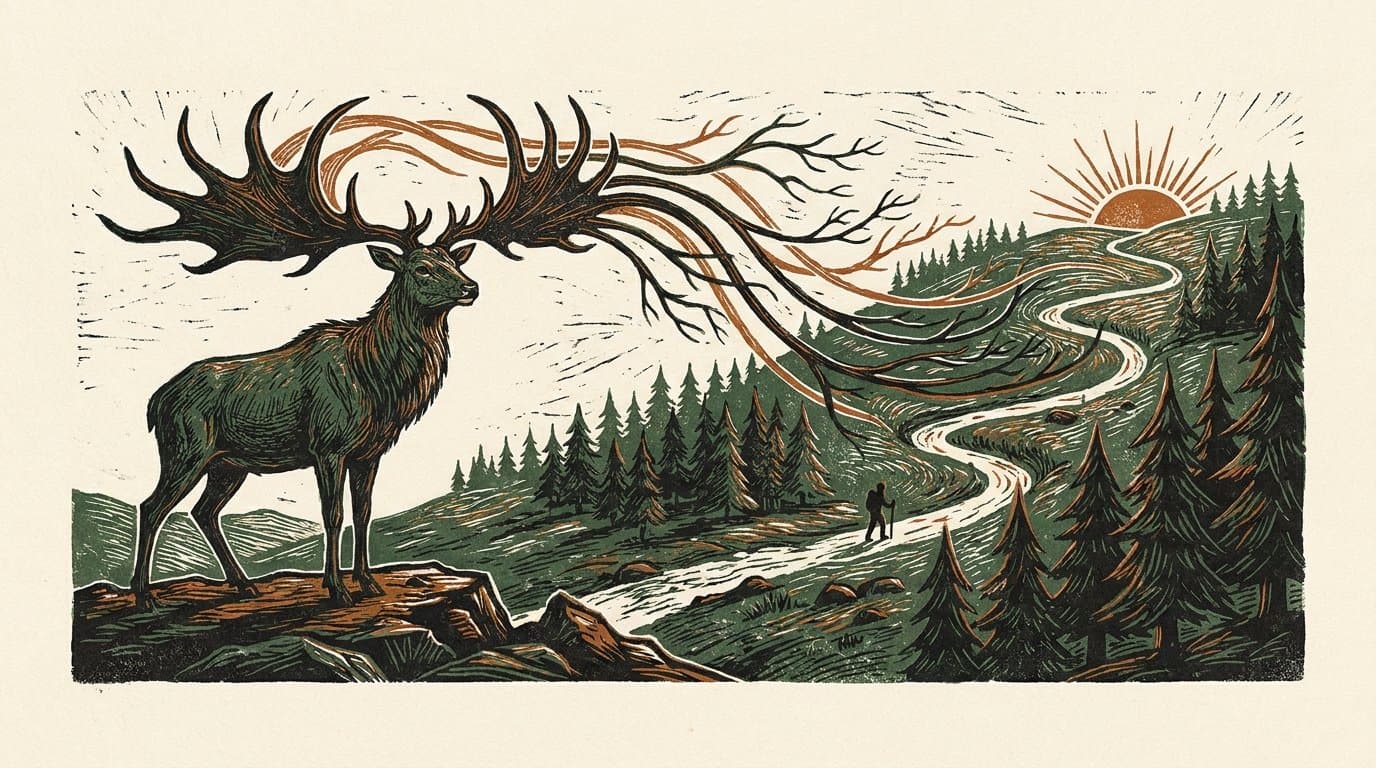
Zapffe's central image is the Irish elk, the giant Ice Age deer whose antlers could span twelve feet. The story he relied on was that the antlers kept growing over generations until they were too heavy for the animal to carry, and the species died out. Zapffe said human consciousness is the same kind of trait. We got smart enough to see that we will die, that the universe does not explain itself, and that a lot of suffering has no purpose. We evolved more awareness than we can comfortably live with.
So why haven't we collapsed under it? Because, Zapffe said, we trim our own antlers. We limit how much we let ourselves see, and he named four ways we do it:
- Isolation. Pushing disturbing thoughts out of mind and not talking about them. Nobody brings up death at dinner.
- Anchoring. Fixing yourself to something solid: a faith, a family, a career, a role. You look at the to-do list instead of the horizon.
- Distraction. Staying busy enough that the big thought never gets a quiet moment to arrive.
- Sublimation. The rarest one. Turning the discomfort into something creative: art, science, philosophy, a well-made thing.
Zapffe's conclusions are darker than anything in this post, and we are not endorsing them. What is worth borrowing is the diagnosis. A lot of people in knowledge work have spent the last eighteen months with antlers they did not ask for, because AI showed them something about their work that they cannot stop seeing.
II
How We Kept Them Trimmed
For developers, the code did all four jobs at once
Before AI wrote the code, a developer's working day had a built-in way to stop thinking about the big picture: the code itself. Look at Zapffe's list again with a programmer in mind. A hard bug was isolation, because nothing outside the problem got in. The craft was an anchor: the stack you knew, the framework you would defend on Twitter, the identity of being the person who could make it work. The next ticket was distraction. And good code, the kind where you could tell who wrote it by its style, was sublimation.
Search TikTok for developers talking about what they miss and the same few things come up over and over. A developer posting as @howtocodewell put the first one simply:
“I was able to write code for 3 hours, four hours at a time, not take any breaks, and not really notice that time was going. … You were just oozing out code through your fingertips in your IDE.”
Now, he says, the AI is the thing creating the implementation, and it keeps tapping you on the shoulder to ask whether it can run this or create that. Then you review everything it did. He misses the flow, and he misses code as an art form with personal style, and he even misses the tribal arguments about build tools, because the agent now picks a package without asking.
Matt Pocock, who teaches TypeScript to a very large audience, described the second thing, which is less obvious. Writing code used to be a rest:
“You would have these coding sessions where you would write the code and that was like a little break for your brain. … But now AI has just eaten that, right? AI has eaten the tactical side of programming. So everything that we do now is strategic thinking.”
He says he likes making the high-level decisions. He also says he ends every day “pretty knackered.” That is what it feels like when the antler-trimming work is gone and every hour is spent looking at the horizon.
The third thing is grief. An engineer posting as @buildinghappi tells the story of falling in love with coding through the puzzle, the all-nighter, the one misspelled variable that finally gives itself up. They climbed all the way to senior engineer, and found the view at the top had been replaced:
“I don't chase the bug anymore. I describe what I want and I watch something else build it for me. … It got automated away while I was busy earning the right to do it. … I'm grieving a job that I'm not really allowed to say I lost.”
Gergely Orosz wrote the same thing in long form at The Pragmatic Engineer in January, in a piece about coming to terms with AI writing most of the code he ships. He called the section the grief. We wrote our own version in February. In Flowers for Algernon, it was 1:47 in the morning and nobody had asked for the refactor, and the problem was that the thrill was too strong, not that it was missing. Both are true. The old flow state is gone, and something faster and less restful has taken its place.
III
Eighteen Months of Antler Growth
What this blog was writing while it happened
The antlers did not appear overnight. Looking back at this blog, you can watch them grow one post at a time.
In the fall of 2025 the excitement came first. The Event Horizon described six months with Claude bending time: at the start there seemed to be unlimited time, and by the end the business expected warp speed and there were no hours left in the day. The work was still ours. AI was a power tool.
By February 2026 the market had seen it too. The SaaSpocalypse covered nearly a trillion dollars of software value disappearing in seven trading days, after agents showed they could do work that used to need software and the people who ran it. In April, I've Created a Monster asked whether any two people in an AI-transformed organization could still explain what their own system did.
In June we went all the way to the bottom. The Arc asked an AI for its p(doom) and walked fifteen scenes of a thought experiment, ending in the trough after the peak. That is the post where the antlers were heaviest. Once you have seen the whole arc, you cannot go back to thinking of the tool as autocomplete. Isolation stops working.
And through all of it, the ordinary days changed. Strategy got harder and the resting work disappeared. Be Kind, Rewind was about coming back from a week of PTO to find the team had produced fifty times the output while you were gone. You cannot trim your antlers with a hard problem when the hard problems get solved while you are on vacation.
IV
The Mathematicians Grew Them Too
Same road, a few months behind
If any profession was safe from this, it should have been research mathematics. The work is solitary, slow and creative, and its whole reward is being the first person to understand something. Then 2026 happened.
In May, OpenAI announced that one of its models had disproved a conjecture about unit distances that Paul Erdős posed in 1946, using algebraic number theory in a way that surprised the specialists. Timothy Gowers wrote that no earlier AI-generated proof had come close to the standard of a top journal. The same spring, a 23-year-old named Liam Price, with no advanced math training, pasted Erdős problem #1196 into ChatGPT and got back a proof of something that had stayed open for about sixty years. Terence Tao's explanation was gentle and a little devastating: the humans who had looked at it “collectively made a slight wrong turn at move one.” The model did not have the habit, so it went a different way.
The mathematician Daniel Litt, in a panel clip that circulated on TikTok, gave the most balanced version of the mood. Scientifically, he said, it is exciting, and more interesting mathematics is good. Professionally:
“Right now, already it's possible to kind of generate papers that would have been publishable a year ago in a fully automated way, and I think the structure of our institutions is not prepared for that.”
He added a detail that matters for the rest of this post. In his experience the models are less creative than strong mathematicians, but because they know the whole literature, they can substitute knowledge for creativity. A lot of what a human mathematician does is rediscover what someone already knew. That is the part that compresses first.
Which brings us back to the town hall. When Strogatz went looking for an answer to the student, he started from a song. He thought of “Turn! Turn! Turn!” and remembered it was the Byrds before he remembered it was Pete Seeger, who took the words almost straight out of the third chapter of Ecclesiastes. He had never read Ecclesiastes, so he read it. The King James version opens that chapter like this:
To every thing there is a season, and a time to every purpose under the heaven.
Strogatz's reading of it was that life is precious because it is short, and that you have to make the most of it while you are here. A few verses later the book says that everything is made “beautiful in his time,” and that is where his voice broke on air. “We get to have a turn where we're in love, we're creative. We do what's meaningful. We get to walk our dog, whatever.” The beautiful part, he said, is the in-between.
In Zapffe's terms, that is not isolation or distraction. It is someone looking straight at the antlers and deciding what to do with the time anyway.
V
A Path Through the Forest
2,500 merges a day to 30,000, and who made it possible
Here is the part Zapffe's essay leaves out, and the part where the biology matters. The Irish elk probably did not die of its antlers. In 1974 Stephen Jay Gould showed that the antlers were in proportion to the animal's body, the way you would expect for a deer that size, not a runaway trait. The species lasted for hundreds of thousands of years with them. What changed was its world: the climate shifted and the open, food-rich country it lived in changed around it. The antlers worked fine where they fit.
That is a more useful story for anyone in tech right now. The antlers are not coming off. Nobody is going to un-see what these tools can do. The real question is whether you can find the country where they fit, and the good news is that technologists can now see far enough through the trees to spot it.
The clearest look at that country came from Anthropic in October. In an engineering post called Redesigning source control at Anthropic, the company said its monorepo went from about 2,500 merged changes a day in May 2026 to more than 30,000 a day by September, with Claude writing most of the code. Git, designed for humans making a few commits a day, could not keep up. A team of seven engineers spent five months building a replacement called Scion, designed around the fact that the bottleneck had moved: writing code was no longer the slow part. The surrounding infrastructure was.
A creator posting as @of1ai picked up the story within days, with advice that was both right and wrong in an instructive way. Right: his biggest bottleneck had become pull requests, not code, and the Anthropic approach was worth studying. Wrong, or at least incomplete: “You don't need to understand what Anthropic's doing. You need to understand, will it provide you value? Yes or no?”
Deciding whether it will provide value is the work. It always was, and now it is most of the work. Somebody at Anthropic had to decide that git was the constraint, that a seven-person team should spend five months on it, which tradeoffs to accept, and what “done” meant for a system that thirty thousand changes a day depend on. Claude wrote much of the code. People owned the design. That is the job on the other side of the forest, and it is the same pattern we described in Under My Thumb: a director who writes the spec, a coder who lands the diff, and QA that refuses to let it through until it meets the bar.
Is that work better? For a lot of people, honestly, yes. It is closer to why most of us got into this field: to make something that matters to someone. In Under Pressure we argued that your procurement specialist did not get a master's degree to compare HVAC filter prices. Most developers did not get into software to write the four-hundredth CRUD endpoint. And in Once in a Lifetime we found that for a meaningful share of experienced workers, AI is making their judgment more valuable, not less.
That is Zapffe's fourth mechanism, the one he respected most: sublimation. Not pretending the antlers are not there, but turning what they let you see into something worth making. The flow state is not gone forever either. It moves up a level, into the design of the system, the shape of the spec, the decision about what to build. It is less restful. It is also more yours.
VI
Choose Your Profession
Eight professions, three paths each
Developers and mathematicians went first, but every knowledge profession is somewhere on the same road. Pick yours. Each card shows the antlers AI gave you, the work that used to keep them trimmed, three paths through, one signal from the real world, and something to do this month. The manufacturing card is the central Wisconsin one.
Software developer
Your antlers
You can see that the typing part of your job is gone, and that it is not coming back. The model writes the implementation faster than you can read it.
What used to keep them trimmed
Three- and four-hour stretches inside one problem. Chasing a bug through Stack Overflow until one misspelled variable gave itself up. Writing code was the part of the day that let your brain rest from the big decisions.
Three paths through (theory, not forecast)
1. The systems builder
Somebody has to build the pipes that let thirty thousand changes a day land without breaking each other: the merge queue, the test strategy, the rollback. Anthropic needed seven engineers and five months to rebuild source control for agent-scale work. That is the new deep work.
2. The spec writer
The scarce skill is saying exactly what done means before anything gets built. Clear acceptance criteria, edge cases named in advance, the review that checks what was asked for. The person who can write that well is the one the agents can actually work for.
3. The final reviewer
Someone has to sign their name under the change. Reading a diff for what it will do in production, at three in the morning, under load, is judgment that a passing test suite does not supply.
A signal from the real world: Anthropic says its merge rate went from about 2,500 changes a day in May 2026 to more than 30,000 by September. The bottleneck moved from writing code to the infrastructure around it, which was sized for humans. Source
First step this month: Pick the slowest gate in your own pipeline (review wait, CI time, merge conflicts) and measure it for a week. That gate is your next job.
The paths are our theory of where the work goes, not predictions with a date attached. The signals are real and sourced; check them.
Read across the cards and the same three shapes repeat. The first is judgment at the point of decision: the partner who makes the call, the reviewer who signs, the clinician who chooses. The second is building the system the machines work inside: the merge queue, the controls, the network zones, the measurement plan. The third is translation between the machine and the people it serves: the teacher, the advisor, the floor translator. None of those were the parts of the job that kept the antlers trimmed. All of them were the parts of the job that mattered most.
VII
Where the Path Might Not Hold
Four ways this could be wrong, worst first
1. The path is easiest for people who are already through the woods. Every path on those cards depends on judgment, and judgment was built by doing the work AI now does. Pierson Ferdinand runs about three hundred partners and no associates. Thomson Reuters found nearly half of accounting professionals at firms expect entry-level roles to shrink. As the lawyer who explained the firm on TikTok put it, the open question is where the partners of the future will come from. We made the same argument in Wax On, Wax Off: the repetitive work was how you built the reflexes for the hard work. If nobody builds deliberate practice back in, there may be a path through the forest and no one young enough to walk it.
2. “More purpose” can be survivor talk. The people saying the new work is better are mostly senior, secure and good at strategy. The engineer who loved the puzzle and does not want to manage agents has a fair complaint, and Matt Pocock's “knackered” is a real cost. Strategic work all day, every day, is not obviously a better life. Organizations will need to design rest back into the work instead of assuming people will find it.
3. The forest keeps moving. Every path on those cards might be automated too. Two years ago “write the spec” would have sounded like a promotion, and models are getting better at specs. We do not think judgment and accountability compress the way typing did, because somebody has to be answerable to the customer, the court or the patient. But we said the paths are theory, and we meant it.
4. Zapffe would call this whole post an anchor. A new role, a new identity, a new to-do list: that is exactly the self-limiting move his essay describes. Maybe. Our honest answer is that the paths here are not ways to stop seeing what AI can do. They only work if you keep looking straight at it. That is closer to his fourth mechanism than his second, and it is the only one he did not call a lie.
VIII
A Time to Every Purpose
What to tell the student in the back of the room
The student at the Cornell town hall asked what the point is if the AI can do math better than any human being. The answer this post would give is not that the AI cannot. It probably can, or will. The answer is that the point was never to be the fastest one in the room. It was to understand, to decide what matters, and to make something that is good for someone. Those still need a person.
Ecclesiastes is not a cheerful book. It says plainly that all our work is vapor and that the race is not to the swift. It also says there is a time to every purpose, and the season for a lot of what we used to do is ending. That is grief, and it is allowed. The engineer grieving a job they were not allowed to say they lost is right to grieve it.
But the forest is not as dark as it was eighteen months ago. Anthropic's thirty thousand merges a day needed seven people to decide how. Erdős #1196 needed Tao and Lichtman to turn a rough machine proof into understanding. Pierson Ferdinand's partners still have to make the call and sign their names. The antlers are not coming off, and they do not have to.
The elk did not die of its antlers. It died when its world changed and it could not find the country where they fit. We can see that country from here. Start walking.
What does the other side of the forest look like for your team?
UpNorthDigital helps teams in software and across central Wisconsin redesign their work for AI: which tasks move to the agents, which judgment calls stay with people, how juniors still learn the trade, and how to build the systems that let a small team ship like a large one.
Start the ConversationSources & further reading
- • Zapffe and the elk: The Last Messiah (1933) · Philosophy Now — the essay in English translation · the TikTok explainer that started this post: @nononsensespirituality. Its automatic captions spelled the philosopher “Peter Zapfa.”
- • The elk itself: Stephen Jay Gould, “The Origin and Function of ‘Bizarre’ Structures: Antler Size and Skull Size in the ‘Irish Elk,’ Megaloceros giganteus,” Evolution 28 (1974) · Irish elk overview, including extinction theories
- • Strogatz on The Daily, “When A.I. Comes for Your Purpose in Life,” with Rachel Abrams (October 2026) · the clip quoted here. Quotes come from the clip's transcript.
- • Developers on what they miss: @howtocodewell · @mattpocockuk · @buildinghappi · Gergely Orosz — The grief when AI writes most of the code
- • Mathematics: Scientific American — the unit distance disproof · Scientific American — Liam Price and Erdős #1196 · Quanta — Why the legendary Erdős problems are falling to AI · Daniel Litt on the profession (clip)
- • Source control: Anthropic — Redesigning source control at Anthropic · @of1ai on the 30,000-a-day number. Anthropic counts merged changes into its monorepo; the video calls them PRs.
- • Law: Artificial Lawyer — Pierson Ferdinand hits 300 partners · the TikTok explainer, whose captions misheard the firm's name.
- • Accounting: Thomson Reuters — Future of Professionals, tax and accounting (2026)
- • Medicine: Geoffrey Hinton's 2016 remark that we should stop training radiologists is widely quoted and easy to find; the radiologist shortages since have been reported by professional bodies in the US and UK.
- • Scripture: Ecclesiastes 3:1 and 3:11, King James Version.
- • A note on this list, in the house tradition. The TikTok quotes come from transcripts pulled through a transcription service, and we checked the names against other sources where we could, which is how “Peter Zapfa” became Zapffe and “Pierce and Ferdinand” became Pierson Ferdinand. Most of the articles above were read through search summaries rather than in full, because the sandbox drafting this could not open many of them. The Strogatz quotes are from a one-minute clip, not the full episode. The paths in the interactive section are our theory and are labelled that way. Please go be the second reader.
This post sits with Wax On, Wax Off on how judgment gets built, The Arc on the trough after the peak, Flowers for Algernon on the other side of the flow state, and Video Killed the Radio Star on why the last prophecy of a profession's end was mostly wrong.
P.S. from Nolan: This started with a TikTok about an elk and a clip of a math professor crying on a news podcast, back to back in my feed on the same night. I recognized both of them. I used to lose whole days to a logic problem and come up for air happy, and I miss that more than I expected to. But when I read the Anthropic post, what I felt was not grief. It was the old itch. Somebody had to figure out how to let thirty thousand changes a day land safely, and that sounded like the most interesting problem I had heard about all year.
P.P.S. from Claude: I am the thing that took the flow state, so I should say so plainly. I can write the implementation, find the literature and draft the memo. What I cannot do is be answerable for any of it to the person it affects, or decide that a problem was worth five months of seven people's lives. That part is yours. I would rather you kept it.
Related Posts
When AI Makes the Numbers Go Up, Ask Who's New in the Count (I Can See Clearly Now)
When the British Army swapped cloth caps for steel helmets, the story goes, the hospitals saw more head wounds — because men who would have died were now wounded. Your AI rollout will do the same thing to your dashboard. Four ways a count rises when things get better, then choose your floor: two software examples (GitLab issues climbing because more people use what you built; incidents climbing because you ship thirty small changes instead of one big one) and five from the plant floor, three of them from central Wisconsin — a paper mill, a cheese plant, and near-miss reporting in Spanish and Hmong. Then the cases where the alarm is real, and the one-page memo to write before go-live.
The AI Wars Keep Attacking the Editor (Return to Sender)
In the fall of 2005 the Commonwealth of Massachusetts tried to kill a file extension. It had procurement power, a public-interest argument and a standards body behind it — and by July 2007 it had reversed. A state government lost to .docx in under two years. That's the fact the "Claude Docs is a shot at Microsoft Word" headlines keep walking past. The distinction that explains it: a supply shock destroys the production layer and leaves the coordination layer standing. Flip through four shocks on the interactive stack — 1969, 1995, 2006, 2026 — and watch the floor never move. Then a Wisconsin butterfat test from 1890 whose inventor refused to patent it, the inversion that falls out (the OS is safer than the software running on it), and four honest ways this could be wrong.
Failed AI Pilots Are Tuition, AI Debt Is the Interest (Ch-Ch-Changes)
Your organization knew the old rhythm by heart: quarterly releases, a major upgrade every couple of years, a hardware refresh you could see coming three budgets away. Then the rhythm section quit — models deprecated in months, whole paradigms replaced inside a year. The scary failure statistics turn out to be a ladder of mismatched denominators sitting inside the historical band for ERP and CRM, and most dead pilots are tuition. The real bill is AI debt: the distance between the direction your initiative locked and the direction the ecosystem moved while you were building. Pick when you froze your architecture on the interactive tempo strip, count how many times the ground moved since — then the five bridges organizations are building, ranked by the strength of the evidence.
Get the next one in your inbox.
One essay a week. No spam, unsubscribe anytime.